

Starting an AI business in January 2026 feels a lot like buying beachfront property before the road gets built. Businesses already know AI matters, but most of them still don’t know what to do next, or who to trust.
That gap is the opportunity.
Small and mid-sized companies are busy running payroll, handling customers, and keeping operations moving. They don’t have time to test five AI tools, stitch them together, and figure out what’s safe, what’s useful, and what actually saves money.
This guide gives you a simple, practical plan to start, even if you can’t code. You’ll choose one of two beginner-friendly paths (consulting or building), pick one problem to solve, then land your first client using straightforward outreach. If you’ve been Googling the best ai business ideas, this is how you turn an idea into a paid project.
Pick the right AI business path for you (consultant or builder)
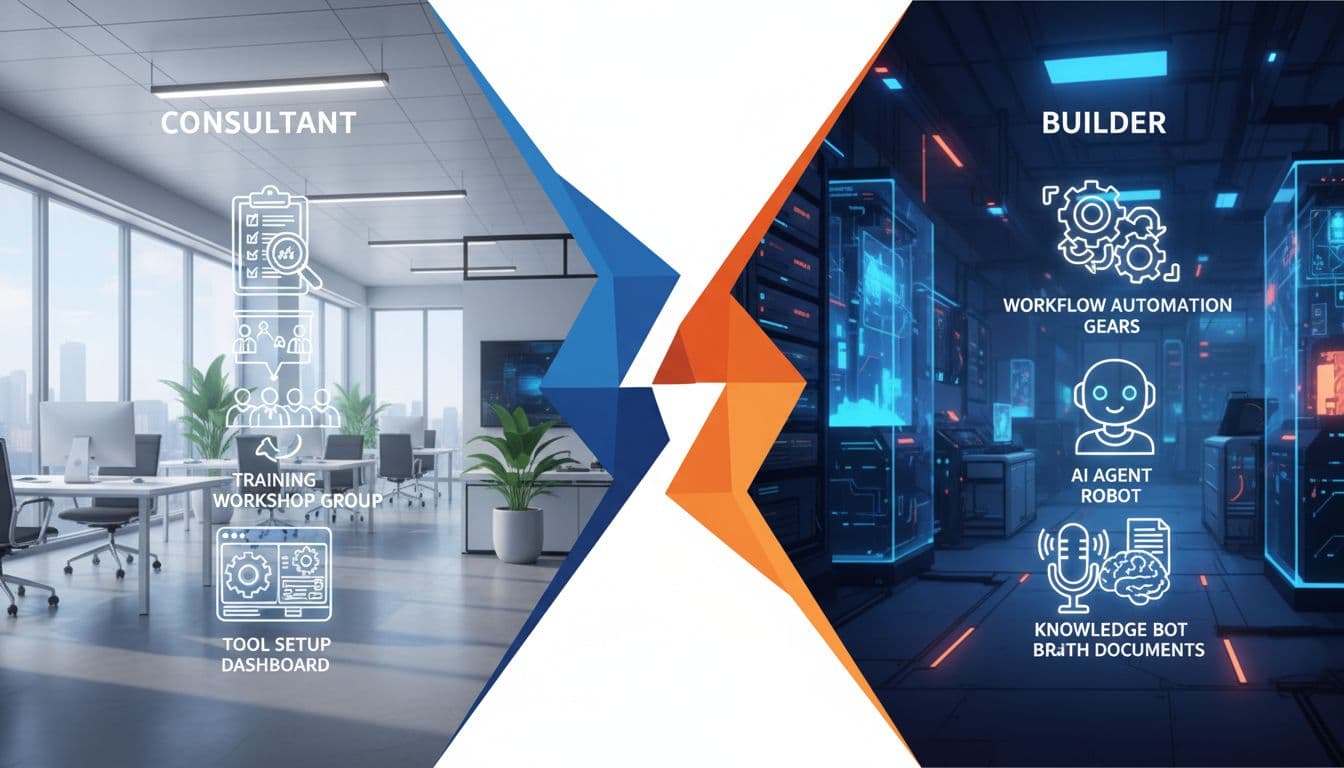 Two common paths: consulting (strategy and training) and building (automation and AI systems), created with AI.
There are two paths that work well in 2026. You don’t need to do both, and you shouldn’t try to at the start.
Path A: Consultant. You sell clarity. You help a business decide what to implement, what tools to use, and what to avoid.
Path B: Builder. You deliver outcomes. You set up automations, AI agents, voice assistants, and knowledge bots that plug into real workflows.
Here’s a quick 2-minute checklist to choose:
- You enjoy calls, explaining things, and leading people through change, choose Consultant.
- You’d rather build quietly, test systems, and ship working setups, choose Builder.
- You have a strong network in one industry, Consultant can monetize that faster.
- You like tools and tinkering, Builder will feel more natural.
- You don’t want heavy selling, Builder can grow through partnerships and referrals.
- You want quick paid discovery work, Consultant fits audits and workshops.
Path 1, AI consultant: sell clarity with audits, training, and simple tool setups
 Photo by Mikael Blomkvist
If you’re not technical (or you just don’t want to build), this path is strong in 2026 because companies feel pressure to get ROI from AI, but they don’t want random experiments.
A beginner-friendly offer here is an AI audit. Think of it like a “home inspection,” but for workflows.
An AI audit is a short project where you:
- interview the owner or team,
- map what they do today,
- find 5 to 10 high-impact places AI can help,
- recommend tools and a rollout plan.
A solid deliverable looks like:
- A simple workflow map (what happens now)
- “Quick wins” list (things you can implement in days)
- Tool recommendations (with cost ranges)
- Risk notes (privacy, mistakes, human review points)
- Next-step plan (what to build first, and why)
In many beginner communities and accelerators, audits have surged as an entry offer because they’re easy to say yes to. They also open the door to bigger implementation work once the scope is clear.
If you want broader context on what businesses expect from AI this year, Clarifai’s 2026 trends overview is a useful skim: Top LLMs and AI trends for 2026.
Path 2, AI builder: deliver automations, agents, voice AI, and knowledge bots
If consulting is the blueprint, building is the construction crew. In 2026, buyers pay more for systems that plug into operations and save time every week.
Here’s the builder “ladder” from easiest to more advanced:
1) No-code automation (fastest start).
You connect tools like forms, email, CRMs, spreadsheets, and Slack. Tools like Zapier, Make, and n8n are common.
2) AI agents that do small tasks.
Examples: auto-draft replies, summarize calls, route leads, generate quotes, update a CRM, prepare follow-ups.
3) Voice AI for calls and booking.
This is a big one for local businesses that miss calls. If the phone doesn’t get answered, revenue disappears.
4) RAG knowledge assistants (document-based bots).
These bots answer using the company’s real docs, like policies, FAQs, SOPs, and product info. A strong starting reference is this practical guide: RAG implementation guide.
One important market shift: basic “website chatbots” are commoditized. Many businesses tried them already. What they want now are systems that connect to real data and real workflows.
This lines up with broader adoption trends too. Zapier reported that many enterprises plan to increase spending on agentic AI in 2026: 84% of enterprises plan to boost AI agent investments in 2026.
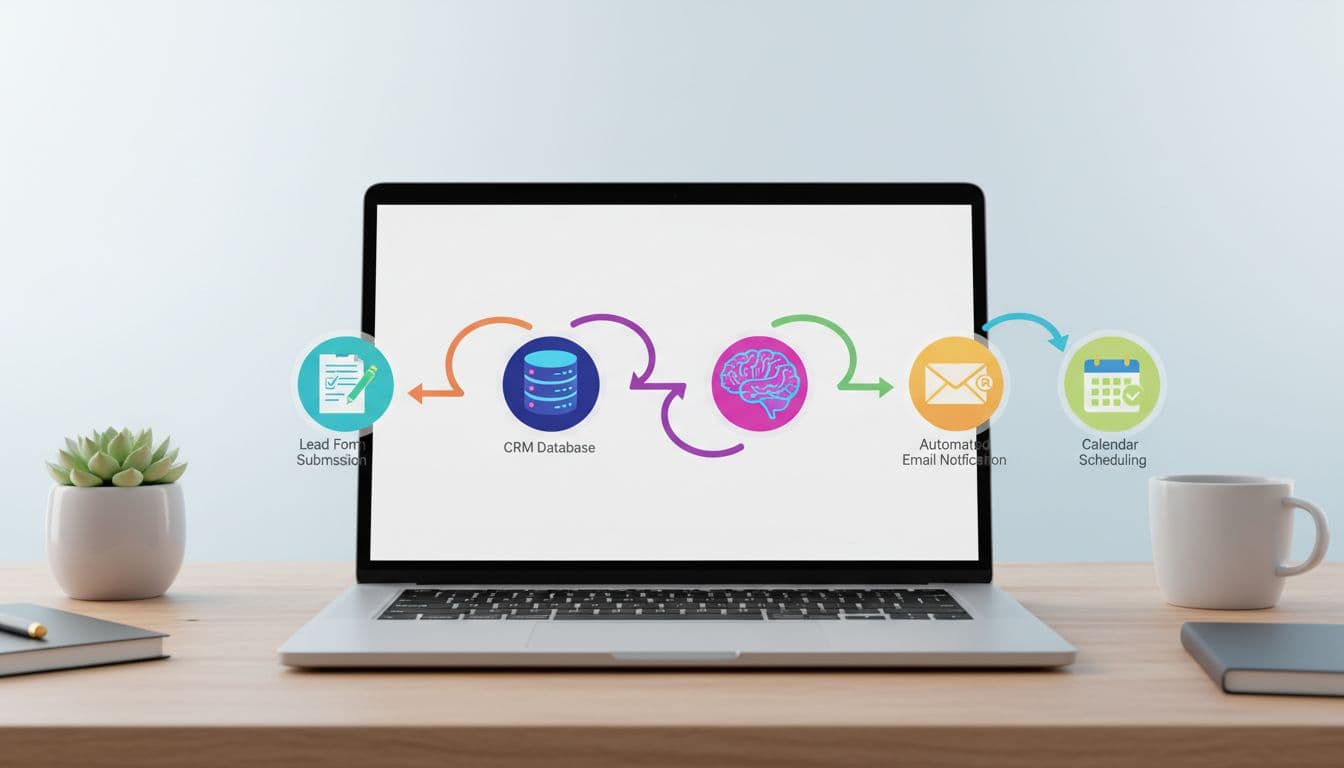 Example of a simple workflow automation with an AI step, created with AI.
Step-by-step plan to get your first client fast (without ads or a big audience)
You don’t need ads to start. You need conversations, proof, and one offer that’s easy to say yes to.
A realistic 7 to 14-day plan looks like this:
- Pick your path (consultant or builder).
- Pick one niche you can access fast (through location, contacts, or past work).
- Pick one pain with a clear cost (missed calls, slow quotes, messy inbox).
- Write one simple offer (audit, automation quick win, or pilot).
- Send warm outreach daily (10 to 20 messages a day).
- Book 3 to 5 short calls and diagnose the problem.
- Run a small pilot (free or low-risk), then turn it into a paid package.
A key pattern from large beginner communities: people often land first clients quickly using warm outreach (people they already know or can reach directly), and momentum tends to jump when they start with a small free project to earn a case study. The ethical framing matters: you’re not pretending to be a Fortune 500 AI team, you’re testing a defined outcome, with guardrails, and creating value.
Step 1, pick one niche and one pain (make it easy to say yes)
Start with niches that already pay for time-saving help and have repeat admin work:
- Local services (plumbers, HVAC, roofers)
- Real estate teams and mortgage brokers
- Accounting and bookkeeping firms
- Dental, med spa, clinics
- Trades and home improvement
- Agencies (marketing, staffing, recruiting)
Then choose one measurable pain. Examples:
- Missed calls and slow callbacks
- Quotes take days, leads go cold
- Staff spends hours on follow-ups
- Customer questions pile up
- Inbox is chaos, tasks get missed
Use this template to keep your pitch clean:
“I help [type of business] reduce [pain] using AI, without changing your whole system.”
You’re not selling “AI.” You’re selling fewer missed leads, faster quotes, and less admin.
Step 2, use warm outreach to book conversations and a small test project
Warm outreach is simple: message people who already have context on you (past coworkers, clients, friends, local business owners, LinkedIn connections). It works because trust is already there.
Here are three short scripts that don’t feel spammy.
Text message script
“Hey [Name], quick question. Are you seeing more admin work lately (calls, follow-ups, inbox)? I’m doing a small AI setup project for a couple businesses to cut that workload down. Want me to take a look at your process and share a few quick wins?”
Email script
Subject: Quick AI time-saver idea for [Business Name]
“Hi [Name], I’m helping a few [niche] teams reduce [pain] with small AI automations (nothing complex, no big system change). If you’re open, I can do a short review and suggest 3 improvements. If one looks good, I can build a small pilot.”
LinkedIn DM script
“Hey [Name], I’m working on AI workflows for [niche]. If I could remove one repetitive task from your week (lead follow-up, scheduling, intake, reporting), which one would you pick?”
When someone bites, offer a limited pilot:
- 7 days
- one workflow
- clear success metric
- permission to use it as a case study if it works
That’s not charity. It’s you buying speed and proof.
For extra idea prompts, Shopify has a solid list to spark direction: AI business ideas to make money in 2026.
Create offers people actually buy in 2026 (pricing, deliverables, and proof)
In 2026, companies are less impressed by demos and more impressed by outcomes. They want AI that saves time, captures revenue, or reduces mistakes.
What sells well right now:
- Workflow automation (reliable and ongoing)
- Voice AI receptionist-style systems (huge for missed calls)
- RAG knowledge assistants (answers based on company data)
- AI audits (strategy and quick wins)
What’s often commoditized:
- Basic “ChatGPT wrapper” chatbots with no real integration
- Generic content generation as a standalone offer
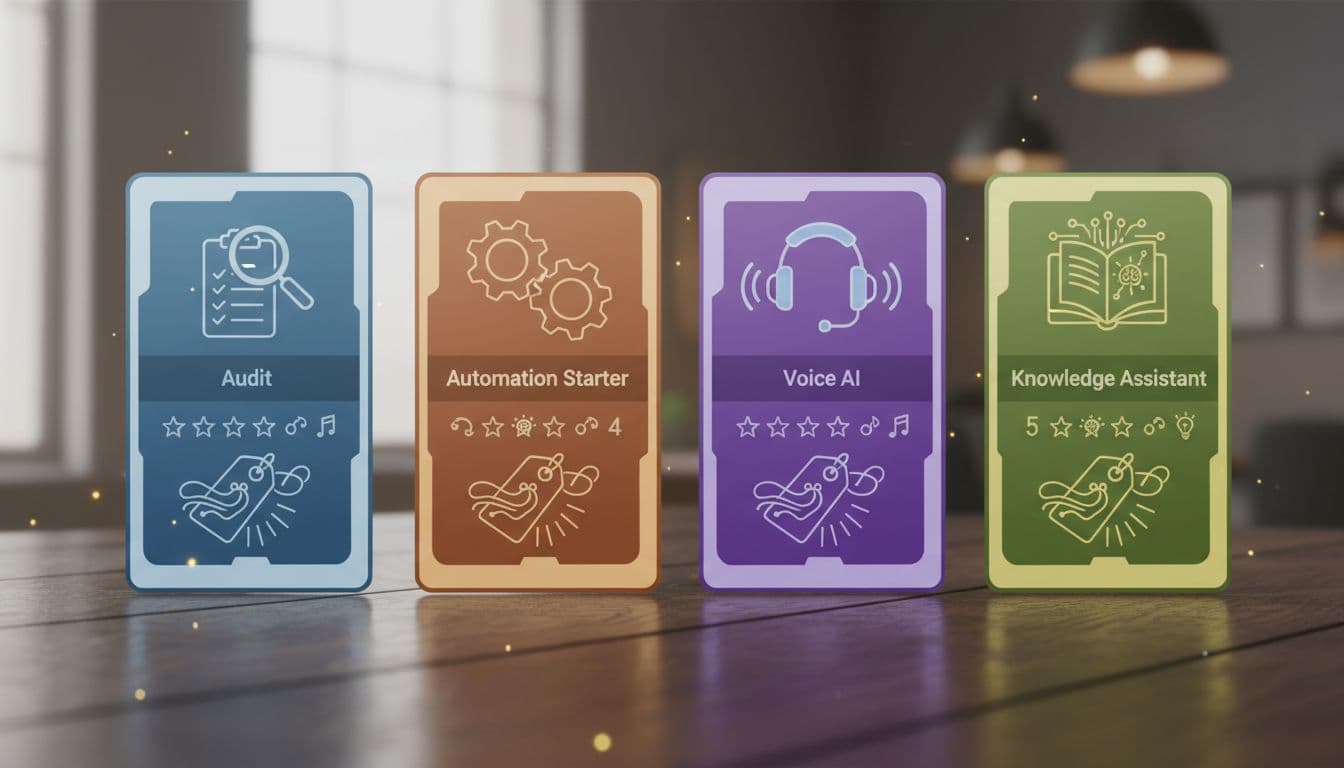 Examples of packaged AI services people understand quickly, created with AI.
Starter offers that close: AI audit, automation quick wins, and voice AI pilots
Here are three beginner-friendly packages you can sell this month.
1) AI Tools Audit (1 to 2 weeks)
Best for: consultants, operators, anyone good at diagnosing
Includes:
- 60 to 90-minute intake call
- workflow map and friction points
- 5 to 10 recommendations with tool options
- quick-win rollout plan Outcome: clarity, priorities, and a clean next step
2) Automation Quick Wins (3 to 7 days)
Best for: builders, no-code automation starters
Includes:
- one workflow built end-to-end (example: lead form to CRM to email to calendar)
- error handling (what happens if data is missing)
- basic training video or handoff doc Outcome: hours saved weekly, fewer dropped leads
3) Voice AI Pilot (7 to 14 days)
Best for: local services and appointment businesses
Includes:
- define call intents (book, reschedule, FAQs, triage)
- connect to scheduling or ticketing
- call logs and human fallback Outcome: fewer missed calls, faster booking
A smart business model in 2026 is the handoff: audits lead to builds. The audit makes the scope obvious, then implementation becomes a confident “yes.”
Partnerships help too:
- Consultants can bring a builder in and earn a referral fee.
- Builders can partner with consultants to avoid doing all the selling.
Simple pricing and value ladder to reach $10K per month
You don’t hit $10K per month by guessing. You hit it by stacking proof and raising prices as outcomes become repeatable.
A simple ladder that works:
| Stage | What you sell | Typical pricing range | Goal |
|---|---|---|---|
| 1 | Free or low-risk pilot | $0 to $500 | Proof and testimonial |
| 2 | Starter package | $500 to $2,000 | Repeatable delivery |
| 3 | Audit or larger build | $2,000 to $5,000 | Clear scope and plan |
| 4 | Implementation project | $10,000+ | Big outcome, clear ROI |
| 5 | Monthly support | $500 to $3,000/mo | Ongoing value and stability |
In aggregated results shared by large AI business communities, deal sizes have grown a lot since early 2024, and a much bigger share of deals now clear five figures once the scope is tight. The practical takeaway is simple: after you have proof, raising prices is normal.
Stay safe and professional (data privacy, client trust, and basic guardrails)
AI businesses win on trust. One messy data mistake can end a relationship.
Keep it simple:
- Don’t paste sensitive customer data into random tools.
- Get written permission for what data you’ll use.
- Start with lower-risk workflows if you’re unsure.
At a high level, laws like GDPR and CCPA influence how companies handle personal data. You don’t need to be a lawyer to start, but you do need basic guardrails and clean documentation.
A beginner-friendly compliance checklist you can follow today
- Data inventory: what data will the system touch?
- Redaction: remove names, emails, payment info when possible.
- Approvals: get client sign-off before using real customer data.
- Tool settings: turn off training on client data if the tool offers it.
- Access controls: least access needed, revoke access when done.
- Retention: define how long logs and files are kept.
- Human review: humans approve important outputs (quotes, refunds, medical info).
- Fallback plan: what happens when the AI is wrong?
- Logging: save inputs and outputs for debugging.
- Bias and hallucinations: reduce risk by grounding answers in sources, and using “I don’t know” responses plus escalation paths.
What I learned from real beginners starting AI businesses (and how to avoid common traps)
Watching thousands of beginners start from zero makes patterns hard to ignore.
First, the two-path model works because it matches how real businesses buy. Some pay for clarity (audits and training). Others pay for delivery (automation and systems). Trying to blend both on day one often slows you down.
Second, warm outreach beats waiting. In large community data sets, most first clients come from people you already know, and median timelines can be surprisingly short when outreach is consistent. Momentum often jumps again when someone starts with a free project that creates a strong case study.
Third, AI audits are a strong entry offer because businesses want direction before they commit. Once you map the workflow and ROI, the bigger project sells itself.
Common traps that slow people down:
- Selling a basic chatbot with no integration, it’s hard to price and easy to replace.
- Overbuilding before talking to customers, you’ll guess wrong.
- Ignoring outreach, hoping social posts will save you.
- Skipping proof, then trying to charge premium rates.
- Unclear scope, which leads to endless revisions and bad margins.
When consultants and builders partner, both sides grow faster. One finds and frames the opportunity, the other ships the system.
Conclusion
Starting an AI business in 2026 isn’t about being the smartest person in the room. It’s about being the person who picks a lane, solves one painful problem, and delivers a clean result.
Here’s the plan to follow this week:
- Choose a path: consultant (audits and training) or builder (automation and agents)
- Pick one niche you can reach quickly
- Pick one pain with a clear cost (missed calls, slow quotes, admin overload)
- Write one simple offer with a short timeline and clear deliverables
- Send warm outreach daily and book 3 conversations this week
- Run a pilot (free or low-risk), then turn it into a paid package
- Raise prices after proof, and grow toward larger builds and retainers
Pick your path today, send your first 10 messages, and start collecting real-world proof. Action is the only thing that makes this real.


0 Comments