


Building software in 2026 is fast. A working prototype can happen in a weekend. The hard part is picking an idea that people will pay for, month after month.
This guide shares 16 practical ways to find micro saas ideas using real signals: complaints, active spending, keyword demand, and proven marketplaces. An AI micro SaaS is a small, focused app that uses AI to complete one painful job for a specific role (not “AI for everything”).
And yes, $10k MRR is simple math. It can be 50 customers at $200/month, or 500 customers at $20/month. The route you choose changes what you should build.
Start with pain, not tech: 6 fast ways to spot problems worth paying for
If you start with “What can AI do?”, you’ll end up with demos. If you start with “What hurts every week?”, you’ll end up with a business.
A simple way to capture ideas is this one-liner:
Audience + Pain + Outcome + AI assist
Also, favor B2B early. Businesses have budgets, urgency, and clear ROI. Look for repeated patterns, not one spicy comment.
 A workspace view of repeated customer complaints turning into product opportunities, created with AI.
1) Mine software reviews for repeated complaints (G2, Capterra, Chrome Web Store)
Pick 1 to 3 tools in a category, then filter reviews by low ratings. You’re hunting for the same complaint showing up five times or more. Those repeats are your spec.
Common “build the better version” angles:
- Missing integrations people expect
- Confusing onboarding that causes churn
- Reporting that’s “almost useful” but not actionable
Example: scheduling tools often frustrate the recipient. An idea can be “For client-facing teams, scheduling that feels polite, fast, and brand-safe, with AI that suggests times and writes the invite message.”
2) Use Reddit to find loud, honest pain points (and the manual work people hate)
Reddit is messy, which is why it’s valuable. Search inside niche subreddits for phrases like “any tool for”, “how do you”, “this is annoying”, “template”, and “spreadsheet”.
Capture four things:
- who’s complaining (job role),
- the task they’re trying to finish,
- what they tried,
- why it failed.
Upvotes are a weak signal. Repeated threads over months are stronger. When the same workflow keeps showing up, you’ve found a billable problem.
3) Lurk in niche forums and paid communities where professionals talk shop
Public forums are good. Paid communities are better because people discuss what they’re doing at work, with real stakes. Look for vertical spaces: podcast production, e-commerce operations, real estate admin, legal intake, clinic admin, recruiting ops.
Vertical AI wins by being specific. It uses industry terms, default templates, and the right outputs (like a ready-to-send email, not a paragraph).
Also watch for multimodal tasks. People share screenshots, voice notes, and messy PDFs. Those “ugly inputs” are gold for AI micro SaaS.
4) Interview 10 people in one niche and listen for “I do this every week” tasks
Ten short calls can beat a month of guessing. Keep it simple: 15 minutes, no pitch.
Ask:
- What do you do every week that you hate?
- How long does it take?
- What does it cost if it’s wrong or late?
- What tools are involved right now?
Your best ideas will sound boring. Weekly work is recurring revenue.
5) Watch X (Twitter) and build-in-public threads to catch new workflow trends early
Follow builders and operators who share what’s working and what’s breaking. Hashtags help (#MicroSaaS, #BuildInPublic, #AIagents), but the real insights are in replies.
Good signals to screenshot:
- “This saved me 5 hours” (clear ROI)
- “I churned because…” (clear retention issue)
- “Does it integrate with…” (clear distribution hook)
Reply threads are a free research panel, and they often show what people want next.
6) Use Discord and Slack groups to see what tools people already pay for and still hate
Chat groups reveal stacks. People casually mention what they pay for, what they switched from, and what they still patch with spreadsheets.
Keep a “Pain Swipe File” with:
- a link to the message,
- the role and niche,
- the tool they pay for today,
- the missing outcome.
One note: get consent before you scrape anything, and don’t spam DMs. Respect community rules.

Steal like an artist: 6 ways to find validated micro SaaS ideas with proof of demand
The fastest path is not inventing. It’s improving. Someone has already found a painful problem, charged for it, and proven buyers exist. Your job is to niche down, simplify, or remove a manual step with AI.
7) Study founder case studies to see what already works, then improve it
Founder stories show what customers actually bought, not what founders hoped they’d buy. Look for details: pricing, distribution channel, build time, and why customers stayed.
When you read stories, ask:
- Can I do this for a tighter niche?
- Can I remove one step with an AI agent?
- Can I make onboarding shorter and clearer?
If you want a reminder on what breaks early traction, keep this handy: Avoid product‑market fit mistakes in SaaS.
8) Browse micro startup marketplaces to see what people buy (pain is real)
If it sold, the pain was real. Marketplaces also teach you what buyers value: simple use cases, stable retention, low support load.
Start here: Acquire.com marketplace. When you browse, don’t just copy. Reverse-engineer what made the product attractive (niche, promise, pricing, and acquisition channel), then build a cleaner version for a specific role.
9) Track Product Hunt and AppSumo launches to spot winning angles and missing features
Launch sites are less about hype and more about objections. Read comments like you’re looking for a leak in a boat.
Patterns to watch:
- “Needs X integration”
- “Too complex for my team”
- “Pricing is confusing”
- “Output isn’t reliable”
Those are idea seeds for a narrower product with a stronger promise.
10) Use verified revenue lists to filter for ideas with real paying customers
Verified metrics remove fantasy. Even without deep financial access, lists and profiles that show revenue ranges and customer counts can help you focus on ideas that already have buyers.
A practical target range is $1k to $10k MRR. Products at that size are often good, but not finished. You can still out-execute with better onboarding, a specific vertical, or one killer integration.
For examples of AI-focused micro startup thinking, browse: Microns AI micro-SaaS examples.
11) Turn ready-made automations into products (front end plus payments)
There’s an underrated play here: treat workflows as ready-made SaaS backends. Many automations already do the hard part (scrape, extract, summarize, transform, generate).
Productizing is often:
- a simple UI,
- authentication,
- billing,
- a narrow promise,
- logs and retries (so it doesn’t break silently).
This is how a lot of small tools become sellable SaaS. Build the “one-button result,” not the “toolbox.”
12) Use “clone, niche down, and add an AI twist” as a safe idea framework
Cloning without thought is lazy. Niche cloning with a clear upgrade is smart.
Use this checklist:
- Pick a proven category (scheduler, CRM add-on, reporting, inbox helper).
- Pick one role (ops manager, recruiter, clinic admin, agency owner).
- Pick one workflow step to automate.
- Add a measurable outcome.
Examples:
- AI agent that drafts weekly client updates from call notes and project status.
- Multimodal agent that turns voice notes into a formatted proposal and sends it for approval.
Let data pick for you: 4 research methods to find low competition demand in 2026
In 2026, tailwinds are clear: agentic AI (tools that act), multimodal inputs (audio, screenshots, PDFs), and vertical AI (industry-specific defaults). Data helps you choose which wave has room for a small product.
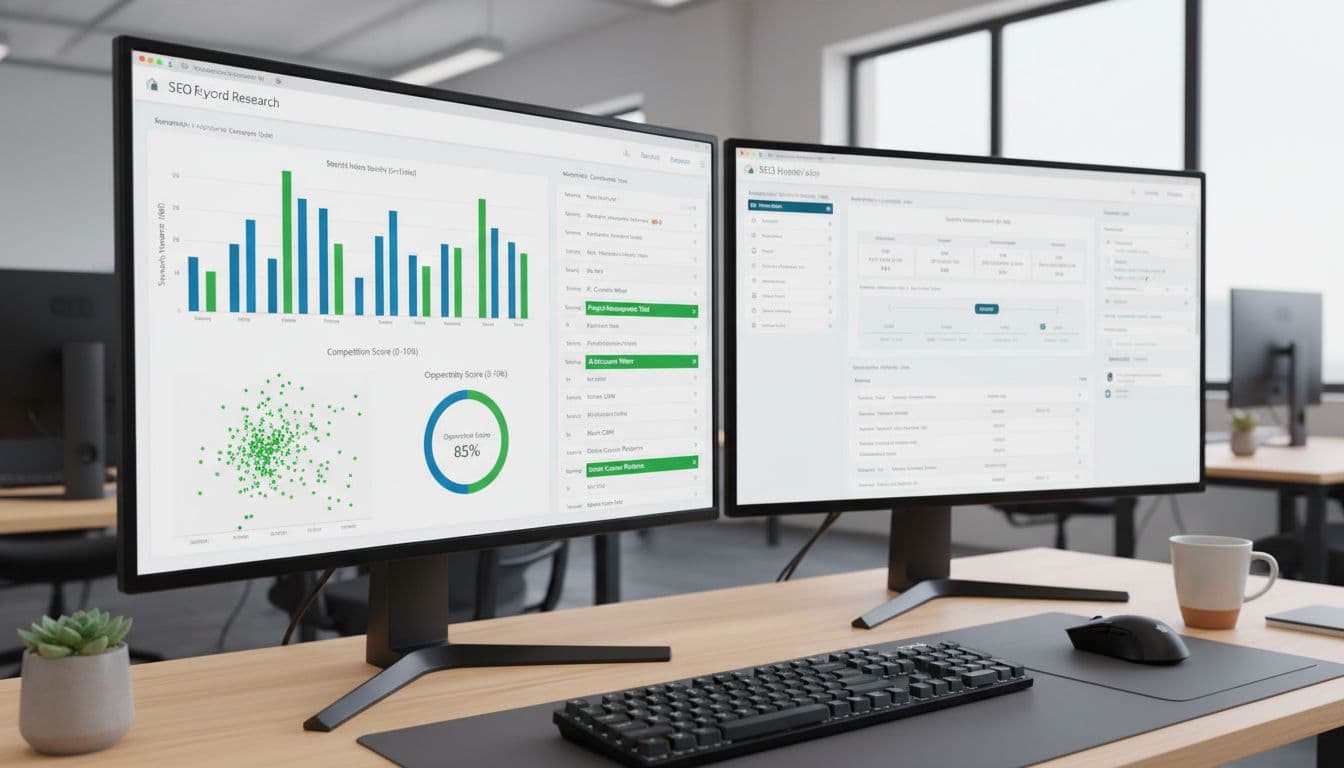 A keyword research setup showing demand and competition signals for product ideas, created with AI.
13) Find high volume, low competition keywords, then build a tiny tool around the keyword
This is the “keyword-first product” approach. Instead of praying for distribution later, you start with existing demand.
Use a keyword tool to find terms with high search volume and low competition, then build the simplest tool that satisfies that intent. Often, it’s a directory, calculator, generator, checker, or lightweight AI agent.
A real-world pattern: someone finds a low-competition keyword like “free AI apps” and builds a directory that grows on organic traffic. The product is simple, the intent is clear, and SEO does the heavy lifting.
14) Use Google Trends and trend trackers to ride rising waves before they peak
Trends can mislead, so use them as a “first signal,” not proof.
Watch for rising workflows like:
- AI agents for lead follow-up
- SOP generator for small teams
- podcast repurposing pipelines
- note-to-content systems (text plus voice)
Then confirm with a second signal: repeated forum posts, launch comments, or marketplaces showing similar tools selling.
15) Spy on where competitor traffic comes from, then serve the same audience with a narrower promise
Competitors are accidental teachers. If a competitor ranks for many “how to” pages, there’s usually a gap between advice and execution.
Look for underserved intent:
- pages that get traffic but have weak conversion,
- keywords that imply a job-to-be-done,
- users asking for one integration over and over.
Then build a niche MVP that does one thing better: faster output, cleaner UX, fewer steps, or one integration the big tools ignore.
16) Use AI idea agents to scrape conversations and output idea briefs, then save them automatically
Some idea tools act like research assistants. They scan places like Reddit, Facebook groups, and niche forums, then produce an “idea brief” with the problem, audience, monetization, and a go-to-market outline.
One practical tip: free plans often delete ideas after a day. If you don’t want to pay yet, set up a simple automation that saves each brief to a spreadsheet or Notion. That way you can score ideas later, instead of losing your best leads.
What I learned while hunting micro saas ideas (and how to pick the one you build)
I used to treat idea hunting like a one-time event. Find “the one,” then commit. That mindset slowed everything down.
What works better is treating idea generation like a pipeline. I aim to collect 10 to 20 ideas a week, then score them fast. I don’t marry an idea. I pick three, test quickly, and let the market vote.
A few lessons that keep paying off:
- Repeated pain beats clever tech. The boring weekly task wins.
- B2B is simpler to monetize. A $200/month tool is normal if it saves hours.
- Distribution is part of the product. Keyword-first tools can get traffic early.
- Workflows productize well. A good automation plus UI plus billing becomes SaaS.
- Speed matters more than confidence. Prototypes are cheap, waiting is expensive.
- Ethics matter. Don’t scrape private data, follow platform rules, and get consent.
 A simple scoring sheet for deciding which idea deserves a week of testing, created with AI.
My quick scoring checklist: demand, pain, speed to MVP, and pricing power
I score each idea from 1 to 5:
- Demand: Do people actively search, complain, or buy solutions?
- Pain: Is it urgent, frequent, and costly when ignored?
- Speed to MVP: Can I ship a narrow version in days, not months?
- Pricing power: Can it realistically charge $50 to $300/month for B2B?
“Good” looks like clear ROI and a buyer who already pays for tools. That pricing power is how you reach $10k MRR without needing a massive user base.
My testing loop: pick three ideas, pre-sell, and build only what proves demand
My loop is simple:
- Create a one-page landing page with one promise.
- Talk to 10 people in the niche.
- Ask for a waitlist, a paid pilot, or a pre-sale.
- Build the MVP only if people commit.
Pass signals are plain: they pay, they book calls quickly, or they refer peers. Anything else is a “not now.”
Conclusion
The best micro saas ideas in 2026 won’t come from staring at a blank page. They’ll come from pain, proof, and data: repeated complaints, products people already buy, and keywords that show steady demand.
Pick two methods today, collect 10 ideas this week, score them, choose three, and run a 7-day validation sprint. Focus on one painful workflow, ship something small, and let $10k MRR be the result, not the starting goal.