


You don’t need a complicated funnel, a shiny website, or a paid ads budget to Make Money Online with AI in 2026. What you need is a simple loop you can repeat, and a product that people already buy.
Here’s the honest truth though, this isn’t some overnight miracle. It’s beginner-friendly, yes, and it can lead to your first sales faster than most “online business” ideas, but only if you actually ship something real.
The core loop is almost boring (that’s why it works): (1) find something people already buy, (2) create a simpler helpful version with AI, (3) sell it where buyers already are. And we’ll focus on small digital products like ebooks and templates, because they’re quick to make, cost almost nothing to start, and can sell again and again. AI helps you draft fast, but your human edits are what make people trust it.
Why the simplest AI money method in 2026 is selling small digital products
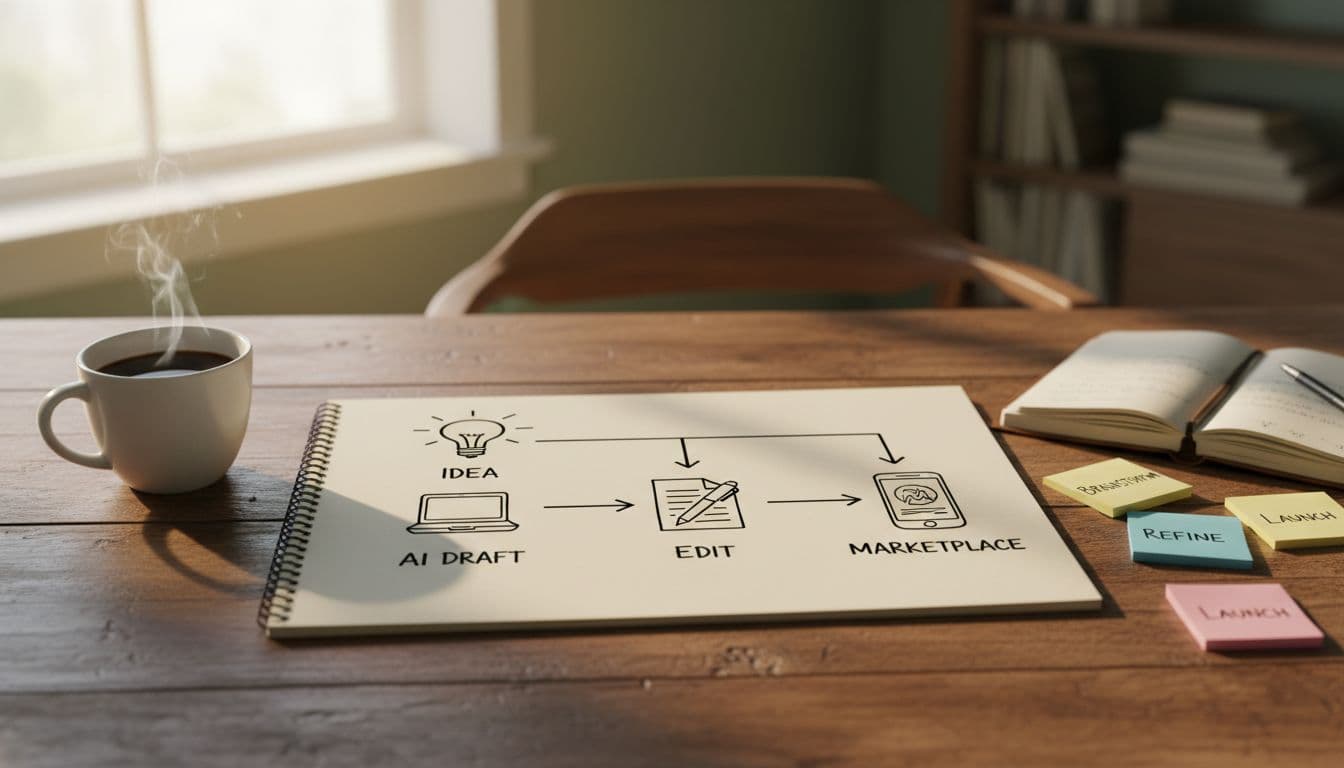 A simple workflow from idea to AI draft to editing to selling, created with AI.
Small digital products are simple for one big reason: you make the file once, and you can sell it many times. No inventory. No shipping. No supplier headaches. No “where do I store this stuff” problem. It’s just a download.
Compare that to tougher paths: running ads before you know what converts, building software, trying to grow a content channel for six months before you earn a dollar, or setting up a complex email funnel that breaks every other week. Those can work, but they’re not the easiest way to start.
In 2026, buyers also expect speed and clarity. People want quick solutions that feel tailored to them. Realtime trend coverage shows hyper-personalization is becoming the default for digital products, meaning people want planners and guides that fit their goals, schedule, or skill level. AI makes that practical, because you can create versions fast, even “custom” add-ons, without rewriting everything from scratch.
If you need inspiration on what’s selling this year, skim lists like profitable digital products to sell in 2026. Don’t copy ideas, just notice patterns: simple outcomes, clear titles, and products that save time.
The one rule, solve one problem clearly (not everything)
Most people buy non-fiction for one reason: they want a problem solved. So your product needs one clear promise, not a giant life makeover.
A great starter size is something you can finish in a day or weekend, like a short ebook around 10,000 words, or a 15 to 30-page template pack. Short doesn’t mean low value. If it gets the reader from stuck to done, they’ll love it.
Think of the difference like this:
“Declutter your bedroom in 7 days without overwhelm” feels doable.
“Fix your whole life with minimalism” feels heavy, vague, and easy to ignore.
How AI helps, and where it can hurt you if you get lazy
AI is excellent for speed. Use it for outlines, first drafts, rewrite passes, examples, and even a cleaner structure. It’s like having a fast assistant who never gets tired.
But if you copy-paste and publish, it shows. The writing gets fluffy, repetitive, and kind of lifeless. Worse, you can accidentally include wrong facts or weird claims. That’s how people lose trust.
A simple quality routine fixes most of this:
- Fact-check anything that sounds specific.
- Add real examples and clear steps.
- Cut filler, especially long intros and repeated points.
- Read it out loud once, it catches awkward lines fast.
AI drafts get you moving. Your edit is what makes it worth paying for.
The 3 step playbook, find demand, create a simpler version, list it where buyers already are
 Researching what’s already selling on a marketplace, created with AI.
This is the part people overthink. Don’t. Treat it like a loop you can run again and again.
You’re not trying to “invent demand.” You’re trying to join demand that already exists, then make a clearer, simpler option.
Step 1, prove people are already buying (so you are not guessing)
Start on the marketplace first, not on a blank Google Doc. For ebooks, Amazon is the obvious place because it has built-in traffic. For templates, Etsy and Gumroad can work too.
When you search a topic, you’re looking for proof that customers are already spending money. On Amazon, one public clue is Best Sellers Rank (BSR). In plain terms, lower rank usually means more sales. Some creators use tools to estimate revenue, but you can start without them by just observing the market.
A rough beginner benchmark some sellers use is looking for books under around 80,000 BSR as a sign there’s activity, but don’t treat that like a law. Categories vary, and Amazon changes.
Quick validation checklist (keep it simple):
- Search the topic and scan top results
- Read a few reviews to spot pain points and gaps
- Note repeated complaints like “too long,” “no steps,” “confusing”
- Write down what your version will do better (faster, simpler, more focused)
Step 2 and 3, build fast with AI, then publish where buyers hang out
“Simpler version” doesn’t mean “worse version.” It means easier to follow. Cleaner structure. Less rambling. More action.
A fast workflow looks like this: outline with AI, draft chapter-by-chapter, edit in your voice, then package it cleanly. For covers, Canva templates are usually enough to start (simple, readable, not busy). After that, format the file, upload, and wait for approval. Many large platforms review new listings in a few days.
One practical tip that keeps working: use your main keyword naturally in the title. Marketplaces have search engines too. If people search “decluttering,” a title that includes “decluttering” is easier to discover than a poetic title that hides the topic.
Make your first sale faster with these beginner friendly choices (and avoid the common traps)
Early sales are never guaranteed. Platforms change, competition is real, and you can’t control algorithms. What you can control is product clarity, basic presentation, and how often you repeat the loop.
Organic traffic still works in 2026 if you keep it light. A few helpful short clips that show a tiny win, a couple Pinterest pins that link to your product, or a value-first Reddit post in the right community can bring the first clicks. Don’t spam. Don’t drop links everywhere. Be useful, then mention your product as the next step.
If you want more proof that small, focused products can earn, it helps to study different models too. For example, this internal story about turning an AI niche app into real revenue shows the same theme: narrow audience, clear result, ship fast.
Best starter product ideas that work well with AI in 2026
Short ebooks are still a clean entry point, but templates and “kits” can be even faster. A few options that pair well with AI drafting:
An ebook that teaches one outcome, like “a 7-day bedroom reset.” A weekly meal prep planner that auto-fills based on diet style. An “AI prompts for real estate agents” pack that generates listing descriptions and follow-up texts. A local business Instagram caption kit that includes hooks, captions, and posting plans.
Faceless video channels and AI freelancing can also work, but digital products are often the simplest because you do the work once, then sell repeats.
For more idea validation, browsing a curated roundup like digital products to sell in 2026 can help you spot what formats buyers already understand.
Mistakes that quietly kill sales (even if your product is good)
The biggest silent killers are boring but real: picking a topic with no demand, making the product too broad, using a generic cover, writing a fuzzy title, and not editing AI text.
If something’s not selling, don’t panic and start a brand-new project. Often the fastest fixes are small: improve the title, tighten the promise, upgrade the cover, and rewrite the first 10 percent of the product so it feels instantly helpful. That’s where trust begins.
What I learned doing this, the small tweaks that made it feel real (and sell)
I realized I wasted time when I tried to be “original” first. Honestly, original is nice, but clear demand is nicer. When I started by checking what people already buy, everything got easier.
Another thing, I stopped trying to solve five problems in one product. The moment I forced myself to pick one outcome, the writing got sharper, the title got easier, and even the cover choices became obvious.
Editing AI output in my own voice mattered more than I expected. AI can draft fast, but it doesn’t know my tone, my little shortcuts, my “here’s what I’d do” moments. That’s the part readers trust.
Reviews were also a cheat sheet. Not for copying, just for seeing what frustrated buyers. If five reviews say “too complicated,” that’s your opening to make a simpler version that people finish.
And yeah, repeating the loop stacks results. Not because it’s magic, but because each round teaches you what buyers respond to.
Conclusion
If you want to Make Money Online with AI in 2026 without building a complex business, keep it simple: pick one problem, validate demand, draft with AI, edit like a human, publish where buyers already are, then repeat. Scaling is mostly doing the same loop faster and better. Take one concrete step today, write your product promise in one sentence, and make it so clear a tired person would still get it.