


If you’ve been thinking about starting an AI business in 2026, you’re not late. You’re early enough that most small businesses still don’t have “their AI person” yet, and the tools are finally usable without a big engineering team.
It feels a bit like standing under an airport departures board. There are a lot of flights, lots of noise, and people selling you “the best route.” But you don’t need the perfect destination, you need one solid first flight that gets you moving and gets you paid.
This guide focuses on Best AI Business Ideas that don’t require huge capital, and that have a realistic path to your first paying client, often through a small paid pilot you can deliver in weeks, not quarters.
 An “AI business ideas map” style workspace image, created with AI.
How to pick the right AI business idea for your budget and skills in 2026
Most people don’t fail because their idea is bad. They fail because they pick an idea that doesn’t match their reality.
Before you choose one of the 10 ideas below, run it through three filters: runway, baggage, and turbulence.
1) Runway (cash and time)
Runway is how long you can operate before you need income. It’s not just money, it’s evenings, weekends, and mental energy. A low-cost service like content repurposing can start under a few thousand dollars. A security-focused boutique might demand tools, training, and insurance, and it can take longer to close deals.
If your runway is tight, choose an offer you can sell and deliver in 4 to 8 weeks. That keeps you out of the “learning forever” trap.
2) Baggage (skills and network)
Baggage is what you already carry: sales skills, design taste, ops experience, compliance knowledge, or a network in a specific industry.
- If you’ve worked in operations, an automation micro-agency fits naturally.
- If you’ve run social accounts or edited video, a content repurposing studio is a clean match.
- If you’ve lived in regulated environments (healthcare, finance, legal), governance and auditing work may feel familiar.
3) Turbulence (regulation and technical depth)
Some ideas have more turbulence. Healthcare and finance require more caution, documentation, and slower buying cycles. Creator services and local SMB automation are usually lighter on compliance and faster to sell.
A good rule for 2026: AI itself is getting commoditized. The edge is applying it to a specific business problem, in a specific industry, with a process you can repeat.
One simple approach works across almost all of these ideas: pick one lane, sell one paid pilot, deliver it, then decide if you double down. Foundation-style AI investing writeups keep repeating the same theme: the winners go narrow and measure outcomes, not vibes.
A simple pricing mindset: sell outcomes, not AI tools
Clients don’t really want “AI.” They want results.
Think in outcomes like:
- More booked calls from the same website traffic
- Faster lead response so fewer inquiries go cold
- More content from one video without hiring a full editing team
- Fewer mistakes and fewer risky AI outputs
- Better forecasts so inventory and staffing decisions don’t feel like guessing
A simple starter format that’s easy to understand is a setup fee plus a monthly retainer. For many low-cost services, the setup can be a few hundred to a few thousand dollars, and the retainer can be a few hundred to a couple thousand a month, depending on scope.
Where the demand is in 2026: automation, creators, security, and training
Four demand waves are doing a lot of the heavy lifting this year.
Automation and AI agents are being adopted fast, with market projections suggesting roughly a 40% jump from 2025 to 2026. That signals buyers are moving from “testing” to “using.” You can track broader trend themes in places like IBM’s 2026 predictions overview: https://www.ibm.com/think/news/ai-tech-trends-predictions-2026
Creators and brands are drowning in content needs. Short-form output keeps rising, but creators still only have 24 hours in a day.
Security and risk concerns are growing too, especially around AI-driven fraud and new attack paths. Vanta’s 2026 security trends roundup gives a grounded look at what teams are worried about: https://www.vanta.com/resources/top-ai-security-trends-for-2026
Training is also booming because companies already bought tools, but teams don’t use them well. Global e-learning is projected to be in the roughly $400 to $495 billion range by 2026, and AI-specific training is a growing slice of that.
Top 10 Best AI Business Ideas you can start in 2026 (low-cost, high-potential)
Fastest to first dollar: simple services you can sell to small businesses
- AI automation micro-agency for SMB workflows
You map repetitive tasks (intake, follow-ups, invoicing) and build automations with no-code tools plus AI assistants. Buyers are local and online SMBs who hate admin work. It works in 2026 because owners want time back and faster response. Startup cost: ~$2,000 to $5,000. First offer: “2-workflow automation sprint” with a setup fee plus a monthly monitoring retainer. - AI-powered lead management and instant response service
You set up web chat, SMS “missed-call text back,” DM replies, and appointment booking so leads get a response in minutes. Buyers are home services, clinics, agencies, and local pros. It works because response speed directly affects revenue. Startup cost: ~$1,000 to $4,000. First offer: “30-minute lead response guarantee” setup plus a monthly retainer for ongoing tuning. - AI chatbot setup service for support and sales
You build a site chatbot that answers FAQs, qualifies leads, routes complex questions to humans, and logs conversations in a CRM. Buyers are businesses with repeat questions and limited staff. It works because chat is cheaper than hiring another person. Startup cost: ~$1,000 to $4,000. First offer: “FAQ chatbot + lead capture” setup with a monthly hosting and improvement plan. - AI appointment and intake assistant for professional services
This is a narrower version of automation, focused on intake forms, reminders, and document collection for lawyers, accountants, therapists, and consultants. It sells well because it reduces no-shows and admin back-and-forth. Startup cost: ~$1,000 to $3,500. First offer: “Intake and booking rebuild” with calendar integration and a monthly support retainer.
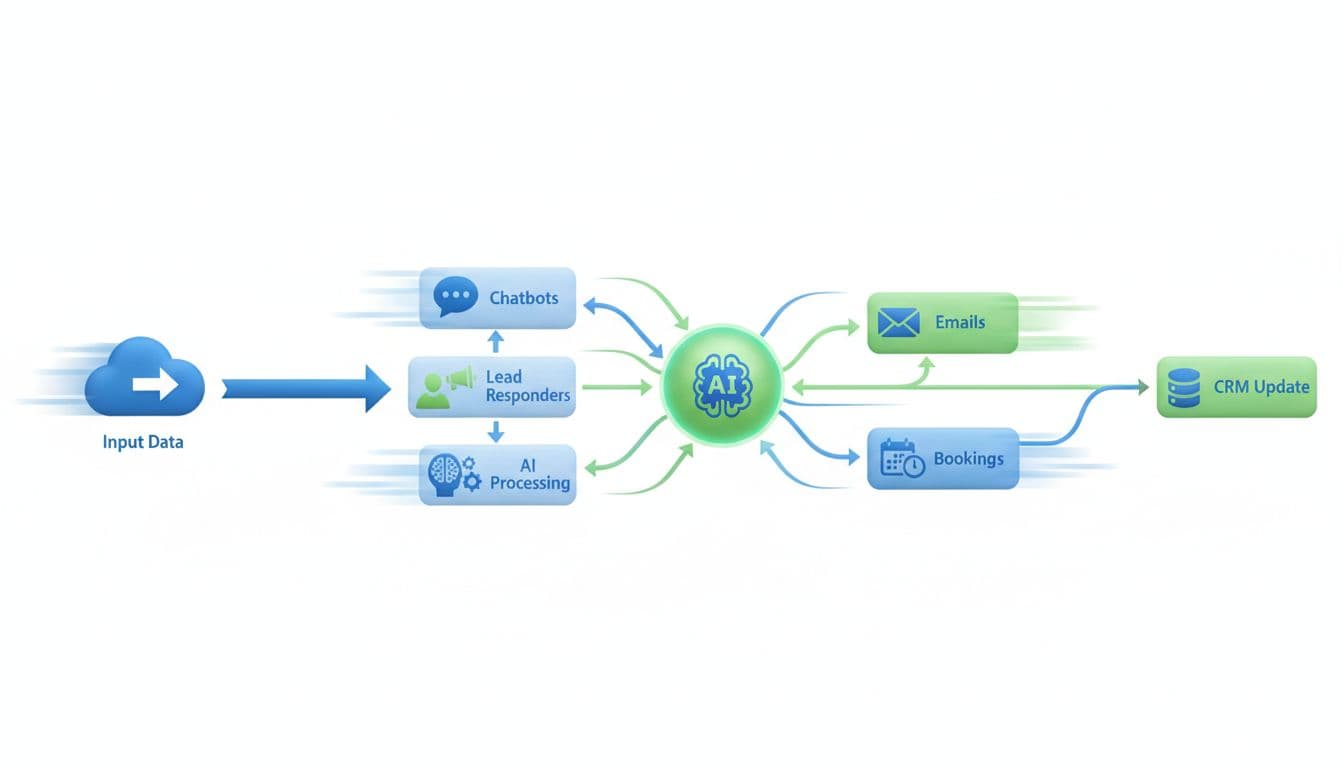 An automation flow diagram showing inputs, AI processing, and business outputs, created with AI.
Creator and marketing offers: low-cost studios that scale with subscriptions
- AI-powered content repurposing and virtual content studio
You take one long video (podcast, webinar, YouTube) and turn it into shorts, captions, titles, thumbnails, blog drafts, and newsletters. Buyers are creators, coaches, and DTC brands trying to post consistently. It works because creators want to record once and publish everywhere. Startup cost: ~$500 to $3,000. First offer: “2 long videos to 20 shorts” monthly subscription. - AI content concierge for blogs, emails, and social posts
This is a writing and editing service with AI support, not “push button content.” You build topic lists, write drafts, add brand voice, and schedule a weekly cadence. Buyers are service businesses and small brands with no in-house writer. It works because content still drives leads, but teams are stretched thin. Startup cost: ~$500 to $2,000. First offer: “4 posts + 1 newsletter per month” with a simple approval workflow. - AI-driven e-commerce personalization agency
You help stores improve conversion rate and average order value using personalization tools and better segmentation. Buyers are Shopify and WooCommerce brands that want more revenue from existing traffic. It works because ad costs are high and stores need higher on-site performance. Startup cost: ~$10,000 to $30,000 (lower if you keep tooling simple). First offer: “Homepage and product recs optimization” with a 30-day test and reporting. Shopify has a helpful overview of AI commerce use cases here: https://www.shopify.com/blog/ai-business-ideas
Trust, risk, and decision support: higher value work with stronger moats
- AI output auditor and safety consultant
You review AI outputs for factual errors, hallucinations, bias, and brand risk. You also create guardrails and escalation rules (when a human must review). Buyers are teams publishing lots of AI-assisted content or deploying AI chat. It works because bad outputs erode trust fast. Startup cost: ~$1,000 to $4,000. First offer: “Baseline output audit” with a risk report and a monthly QA sampling retainer. - AI cybersecurity and identity risk audit boutique
You assess AI-related threats like deepfake fraud, prompt injection, agent hijacking, and identity verification gaps. Buyers are fintech, healthcare-adjacent firms, and B2B companies handling high-value transactions. It works because the attack surface is changing, and boards are paying attention. Startup cost: ~$10,000 to $50,000. First offer: “AI and identity risk audit” with prioritized fixes and training. For more on what’s trending, see: https://www.vanta.com/resources/top-ai-security-trends-for-2026
 A visual pipeline from one piece of content into many outputs, plus a basic risk checklist, created with AI.
10. Predictive analytics and forecasting service for SMEs
A visual pipeline from one piece of content into many outputs, plus a basic risk checklist, created with AI.
10. Predictive analytics and forecasting service for SMEs
You turn messy data into decisions: churn risk, demand forecasts, pricing tests, and inventory planning. Buyers are subscription businesses, retailers, and operators who need clearer numbers. It works because even small forecast improvements can save real money, and SMEs can’t justify a full data team. Startup cost: ~$2,000 to $7,000. First offer: “Single metric forecast” (like demand or churn) with a dashboard and monthly updates.
11. AI education and workforce training micro-consultancy
You teach teams how to use AI tools safely and effectively, with role-based prompt libraries, hands-on practice, and simple policies. Buyers are departments that already have tools but inconsistent usage. It works because training is where adoption becomes real. Startup cost: ~$1,000 to $5,000. First offer: “AI 101 for teams” workshop plus 30 days of office hours. If you want examples of broader idea categories, Nucamp’s 2026 roundup is a useful reference point: https://www.nucamp.co/blog/top-10-ai-business-ideas-you-can-start-in-2026-low-cost-high-potential
My personal experience and what I learned from testing AI business ideas
When I started testing AI service offers, the biggest surprise was how little clients cared about the model or the tool. They cared about whether it worked on a Tuesday afternoon when they were busy.
A few lessons stuck:
Pick one lane for 30 days. Every time I tried to combine automation, content, and analytics, I shipped nothing. One offer, one audience, one clear promise works better.
Sell a small paid pilot first. A short pilot forces clarity. It also creates a clean yes or no moment, instead of endless “let’s think about it” calls.
Use checklists and guardrails. AI can be sloppy when you rush. I learned to build simple QA steps: source checks for claims, brand voice rules, and clear handoff points to a human.
Build simple before complex. A basic lead-response fix can beat a fancy agent. One example: setting up missed-call text back plus a booking link for a local service business can improve follow-up without changing anything else.
Measure one number. Booked appointments, reply time, posts published, reduction in errors, pick one and track it.
 A simple “pilot checklist” scene with before-and-after metrics, created with AI.
Conclusion
You don’t need the perfect plan to start in 2026. You need one of these ideas that fits your runway, matches your baggage, and stays within your turbulence tolerance.
Pick one, write a one-page offer with a clear outcome, then run a paid pilot in the next 4 to 8 weeks. After that, you can earn the right to expand, raise prices, or narrow into a stronger niche.
The people who win with Best AI Business Ideas aren’t the ones who chase every flight. They’re the ones who board one, learn fast, and keep shipping. Which one will you test first?