


Most people who “sell digital products” in 2026 are stuck in the same trap: a $27 ebook, a generic Canva template pack, and a hope that volume will save them. It usually doesn’t. Those markets are loud, crowded, and margins are thin.
The digital products that are quietly printing real money right now don’t feel “cute” or trendy. They feel useful. They solve expensive problems, they target a clear buyer, and they often mix formats (like content plus support, or templates plus implementation).
Below are seven models that can range from about $1k side money to $750k+ scale, depending on price, distribution, and whether you build recurring revenue. These are grounded business ideas for bloggers, YouTubers, creators, and small operators who can teach, build, or systemize.
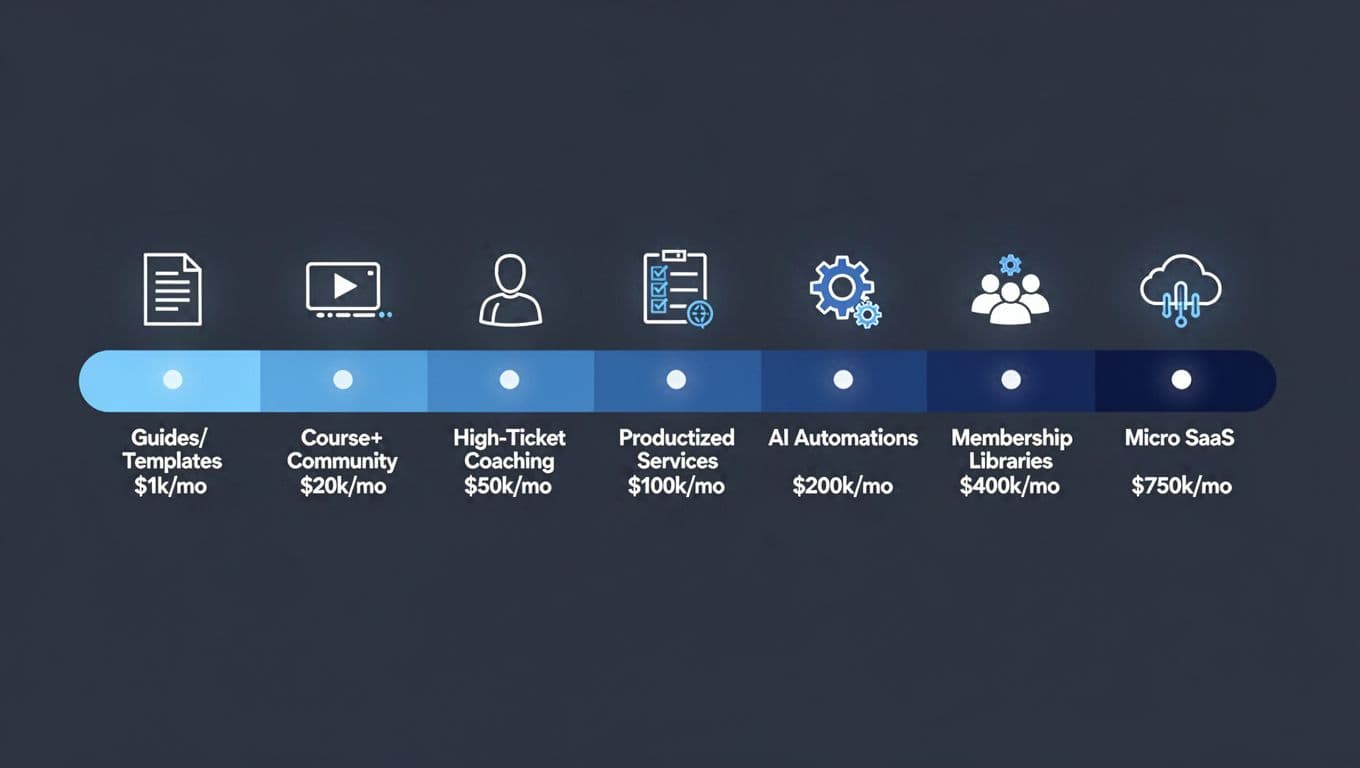 An earnings spectrum for seven digital product models, from low-price volume to high-ticket and recurring, created with AI.
Before you pick a product, use this simple filter so you do not waste months
Pick one model first. Validate demand. Then stack later.
That’s the part people skip. They launch a template, then a course, then a community, then coaching, and nothing gets enough attention to work. It’s like trying to cook seven dinners at once, then wondering why you’re still hungry.
A better plan is simple: start with one offer, get proof it sells, then add a second offer that naturally fits. Course plus coaching works. Template plus done-for-you works. Community plus a tool works. But only after the first one is stable.
The real secret is not “AI” or “funnels.” It’s specificity. Buyers pay for speed, clarity, and outcomes. “Marketing help” is vague. “Shopify store speed fix in 72 hours” is a purchase.
And keep a value equation in your head: if you charge $500, aim to deliver something that feels like $5,000 to the buyer. Not in hype, in real time saved or money gained.
The 3 signs your idea can charge premium prices
Your idea gets pricing power when it hits at least one of these:
It fixes a costly problem. Think: an exam pass plan for a hard certification where failing costs months, stress, and a re-test fee.
It saves serious time. A content creator paying for a content repurposing workflow isn’t buying “editing.” They’re buying back their week.
It helps someone make money. A business paying for a Shopify speed optimization is paying because faster pages can mean fewer abandoned carts and better ad performance.
What doesn’t work? Offers that are soft and foggy, like “life coaching” without a tight outcome, or “I’ll help with your marketing” with no clear deliverables.
Also Read: Food Truck Business Idea: How Fatboy Fried Rice Grew From a Backyard Setup to $55K Months
Price math that makes the range feel real
This is why the same “digital product” label can mean $1k or $750k.
Sell 100 copies at $49 and you’re at $4,900. That’s great, but you need traffic.
Sell 10 seats at $1,500 and you’re at $15,000. Now you need trust and a clear promise.
Close 3 clients at $5,000 and you’re at $15,000 a month, but your calendar fills fast.
Get 1,000 members at $99 and you’re at $99,000 a month, but retention becomes the job.
Get 1,000 SaaS users at $50 and you’re at $50,000 a month, and the business can become an asset, not just income.
7 digital products to sell in 2026, who buys them, and what to charge
A quick note before the list: don’t treat these as “pick one and get rich.” Treat them as business models. Each model has a tradeoff, volume versus sales skill versus support versus build time.
Also, it helps to understand what counts as a digital product (and what doesn’t). Shopify’s overview is a good baseline: what digital products are and how they sell.
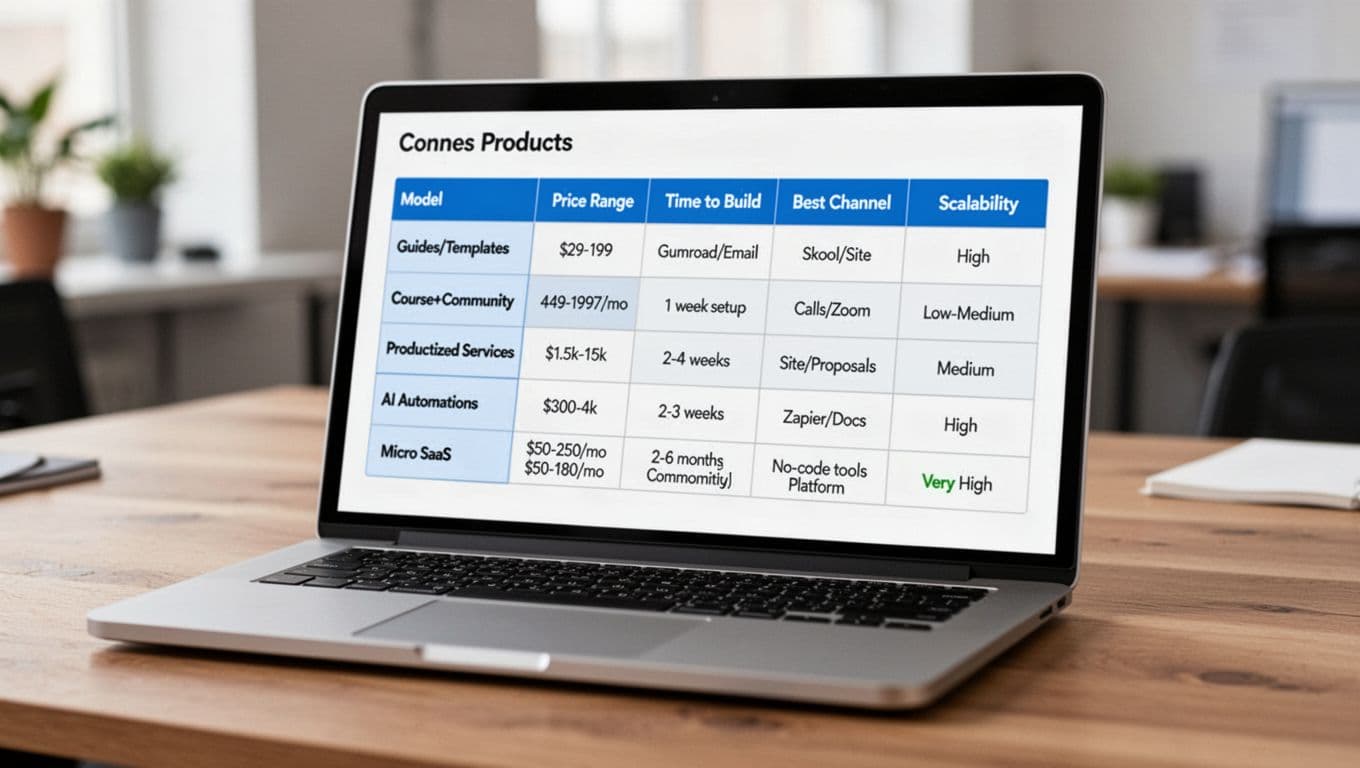 A simple comparison view of seven models, price bands, and scalability, created with AI.
High specificity guides and templates that people actually use
This is the “small but real” model, and it’s where a lot of creators should start. The winners are not generic self-help PDFs. The winners are practical tools that do one job well.
Who buys: busy operators, students, consultants, creators with a deadline.
What you deliver: niche PDFs, checklists, calculators, Notion systems, spreadsheets, presets. Something they can use today.
Pricing: often $29 to $149, with $199+ for “pro” toolkits that bundle templates plus examples plus a mini playbook.
Where it sells: your site and Gumroad are straightforward; Etsy can work when your product fits marketplace search behavior.
Course plus community, because dead video courses do not sell anymore
Standalone video courses feel lonely. People buy with good intentions, don’t finish, then regret it. In 2026, the course that sells is the course with a community layer that helps people implement.
Who buys: people with a clear goal, and usually a deadline.
What you deliver: 10 to 20 core lessons with a tight transformation, plus weekly group calls or live Q and A, plus an active community space (Skool-style communities are popular for this).
Pricing: $49 to $200 per month, or $750 to $1,500 one-time with community access, or cohort-style pricing around $1,997.
Retention reality: if it’s “just info,” churn comes fast. If members get ongoing help and updates, they stay longer, and refunds drop.
High ticket coaching for people already making money, priced like a serious outcome
Coaching is still one of the fastest paths to cash, but only when it’s narrow. “I help entrepreneurs” is a tough sell. “I help creators go from 50k to 200k subscribers with a repeatable format” is a sellable promise.
Who buys: operators with revenue who hit a ceiling and want strategy, not more content.
What you deliver: one-on-one or small group calls, feedback loops, accountability, messaging support, and a clear method you teach and apply.
Pricing: $3,000 to $15,000+, based on outcome and buyer ability to pay.
Simple math: 3 clients at $5k is $15k a month, but you’ll feel it in your bandwidth, so keep delivery tight.
Productized services, the clean fixed scope offer businesses love
Productized services sit between “agency work” and “digital product.” You sell a clear package with a clear timeline and a clear price. No custom quotes, no long sales dance.
Who buys: business owners who want a result without managing you.
What you deliver: fixed-scope deliverables, like a 90-day LinkedIn content calendar with posts written and scheduled, a full email funnel build for a course creator, or short-form repurposing (turn raw videos into a set number of clips per month).
Pricing: often $1,500 to $10,000 per package, with optional monthly maintenance.
Why it sells: specificity reduces decision fatigue. People understand it in five seconds.
AI automation workflows you sell like a product, not like an agency
This one is hot in 2026 because many businesses know they “should use AI,” but they don’t know how to wire it into real work. They don’t want a chatbot. They want fewer mistakes and fewer hours lost.
Who buys: small to mid-size teams with repeatable workflows.
What you deliver: pre-built automations with documentation, like lead scoring and routing, content repurposing pipelines, onboarding flows, follow-up sequences. Tools vary, but the product is the workflow plus setup clarity.
Pricing: around $300 for a simple workflow, up to $4,000+ for a customized setup.
Reality check: if you don’t test and document well, support can eat your week. Clean handoff is the business.
Membership libraries for recurring revenue, but only if you keep it fresh
A membership library is a vault of resources plus ongoing access. People pay monthly because it keeps saving them time month after month.
Who buys: builders who like having a “home base” for templates, SOPs, prompts, swipe files, monthly updates, and office-hours calls.
What you deliver: a growing library plus consistent touchpoints (calls, new resources, reviews).
Pricing: often $50 to $180 per month. Many creators start lower for early members, then raise prices as the library grows.
The hard part is churn. If nothing new happens, people leave once they grabbed what they wanted. Sometimes you need a small team to keep it alive.
No code micro SaaS, the hardest build, but the biggest long term upside
Micro SaaS is a small software tool that solves one workflow problem in an industry you understand. In 2026, no-code tools and AI assistants make building easier than it used to be, but running software is still a real commitment.
Who buys: businesses paying to stop using messy spreadsheets and duct-taped processes.
What you deliver: a focused tool, like a tracker, portal, planner, compliance helper, reporting dashboard, or industry-specific workflow app.
Pricing: $50 to $250 per month.
Scale math: 1,000 users at $50 is $50k a month, and recurring revenue can raise the value of the business.
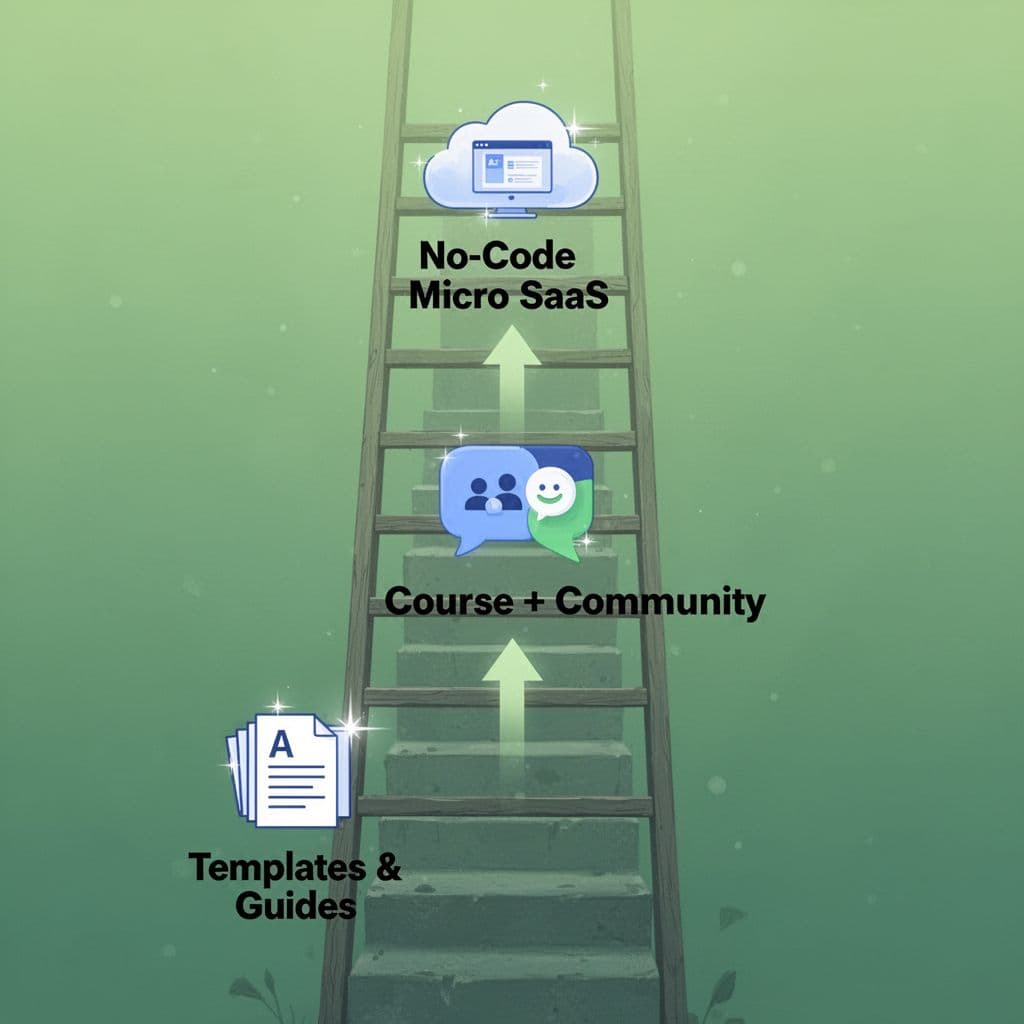 A simple ladder showing how many creators evolve from templates to community to micro SaaS over time, created with AI.
How to choose the best one for you, based on your skills and your audience
The best choice isn’t the one with the biggest number on paper. It’s the one you can stick with long enough to get good.
If you’re strong at teaching, you’ll feel at home with templates, guides, and course plus community. If you’re strong at sales and client work, coaching, productized services, and automation builds can get you paid faster. If you like building systems and can handle support, micro SaaS has the biggest upside, but it’s slower.
If you hate selling, pick the models that sell themselves over time
Guides and templates can work well when you publish consistently and build search traffic. Course plus community can also feel “softer” to sell if you’re already creating content weekly.
The catch is you can’t post once and vanish. Volume and distribution are part of the job, even if you’re allergic to sales calls.
If you like sales and fast cash, pick the premium models first
Coaching, productized services, and AI automation builds can work with smaller audiences because each sale is worth more. But you will talk to customers. You will need to scope clearly. And you’ll need a delivery process you can repeat without losing your mind.
If you want extra perspectives, this video has a decent spread of angles and models to compare: digital products to sell before they get saturated.
What I learned while testing these ideas, and the mistakes I would avoid next time

Photo by Sora Shimazaki
I used to think the answer was “make it cheaper so more people buy.” That was my default. It sounded logical, and honestly it felt safer.
But the cheap, generic stuff is where I got the most pushback. More refunds. More “does this work for my situation?” emails. More noise. I was trying to sell a product to everyone, which meant it landed with no one.
The first time things clicked, it was awkward. I had a small template toolkit priced too low. People bought it, but the buyers who loved it kept saying, “Can you customize this for my workflow?” That was my signal. The template wasn’t the product, the outcome was.
So I raised the price, added a tight promise, and wrote a simple setup guide. Sales didn’t drop like I feared. Support got easier. The offer became easier to explain, too.
My biggest near-mistake was trying to launch three things at once. I almost burned out, and none of them got enough reps to improve. When I slowed down and shipped one clear offer, week after week, results got boring in a good way.
Conclusion
If you want one next step, make it this: pick one of the seven models, write a one-sentence promise (who it helps, what outcome), set a simple price, then validate it with real people.
The best business ideas in 2026 aren’t built on generic information. They’re built on solving costly problems with clear outcomes, delivered in a way people can actually use. If you’re building something this year, which model are you picking, and who’s it for?