


Your business hits a wall. Sales slow down, churn creeps up, your team feels tense, and your first instinct is to push harder.
More hours. More posts. More features. More "discipline."
But a lot of stalls don't come from laziness. They come from something quieter: curiosity fading out, and certainty taking over. When that happens, blind spots grow. And the bigger the business gets, the harder those blind spots are to spot.
AI makes this even sharper in 2026. Answers are cheap now. The rare thing is knowing what to ask, and what to doubt.
 Questioning assumptions at a whiteboard, the kind of moment where curiosity saves founders from expensive mistakes (created with AI).
Why curiosity becomes more important as your business gets bigger
In the early days, curiosity is automatic. You're learning because you have to. Customers don't owe you clarity. The market doesn't care about your plan. So you ask, listen, test, repeat.
Then some wins arrive.
You hire people. You add SOPs. Meetings fill the calendar. The business starts to "run," which feels good. At the same time, certainty creeps in. "This is how we do it." "This worked last time." "We already tried that."
The problem is simple: it's hard to see the whole picture when you're inside the frame. As complexity rises, the cost of being wrong rises too. A small assumption can turn into a big system.
You'll feel it in practical ways: decisions slow down, customer churn surprises you, and competitors ship stuff you didn't even notice customers wanted. That's usually not because you're dumb. It's because you stopped asking the questions that would've exposed the shift early.
The hidden cost of being sure you are right
Certainty feels efficient. It also creates a kind of tunnel vision.
A few quick scenes you've probably lived through (or will):
You copy a competitor's pricing because it "worked for them," but you never asked why it worked. Different audience, different positioning, different margins, same price tag. Ouch.
You add three new features because a loud user asked, then you learn later the quiet majority wanted the onboarding fixed.
You hire only "culture fit," which slowly becomes "people who agree with me," and now meetings are calm but the product gets stale.
Curiosity interrupts that. It nudges you to look for weak signals and ask for evidence before you scale assumptions.
If you want a good reminder that founders still win on routines and learning pace, not just hustle, this breakdown of Lucy Guo's daily routine for startup success is a solid example of disciplined learning habits showing up as results.
Curiosity keeps founders from turning into the bottleneck
When a company is small, the founder is the system. Later, that becomes a trap.
Curious entrepreneurs don't just ask, "What should we do?" They ask questions that remove them from the center of everything, for example:
What decisions can my team make without me?
Where do we keep waiting for approval, and why?
What would "good judgment" look like here, written down?
Those questions create ownership. They also shrink fire drills. Instead of every issue bouncing back to you, learning spreads across the team. You still lead, but you don't strangle the pace.
The 4 curiosity modes successful entrepreneurs balance (and what happens when one takes over)
Curiosity isn't one behavior. It's more like four gears. The best entrepreneurs shift between them on purpose, depending on what the business needs that week.
If one mode dominates, you get predictable problems. Too much exploration and you get chaos. Too much focus and you get rigidity. Too much creativity and you get exciting ideas with no follow-through. Too much openness and you chase shiny stuff.
Here's a simple map you can keep in your head:
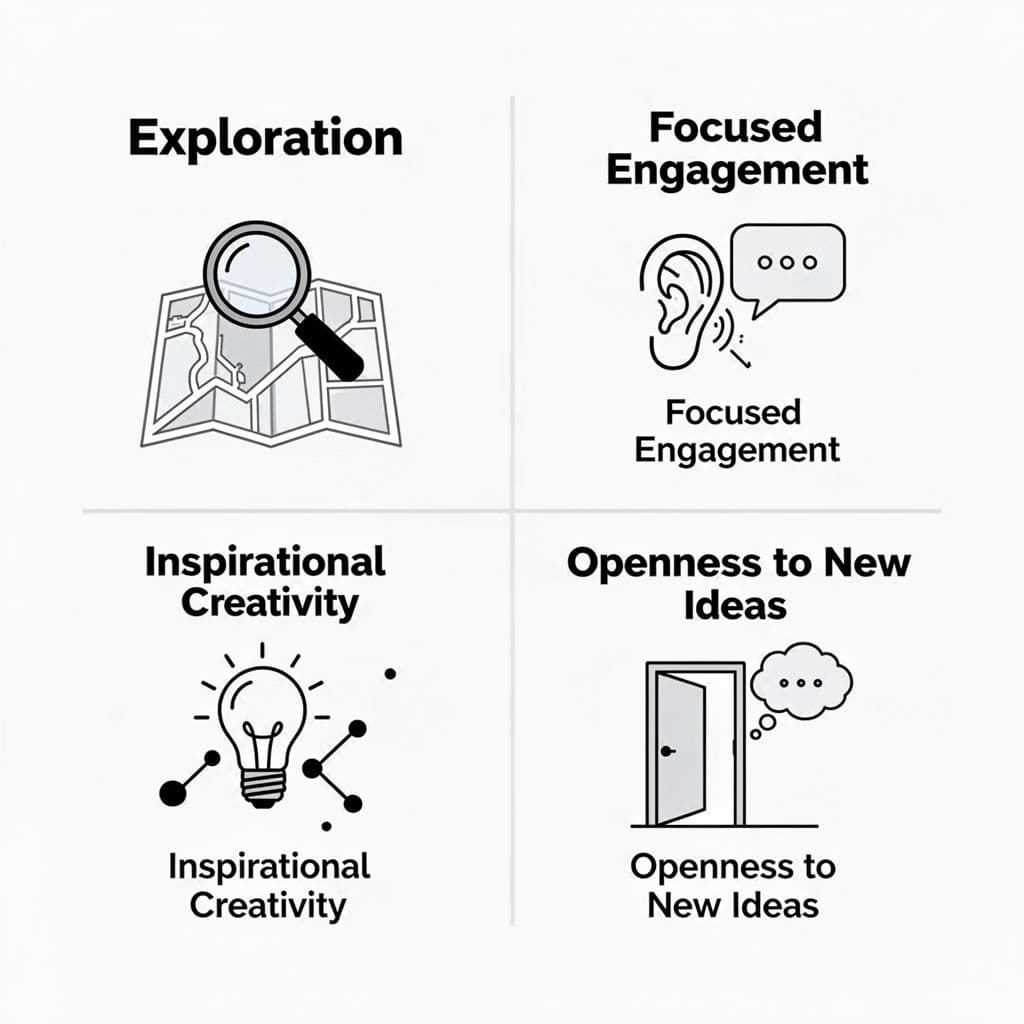 A simple four-mode map of curiosity that founders can use to check their week (created with AI).
Exploration: finding opportunities before everyone else does
Exploration is the scanning mode. You're looking for unmet needs, risks, and weird patterns before they turn obvious.
You don't need a fancy process. Keep it basic:
Talk to five customers and ask what almost made them quit.
Read outside your industry for 20 minutes, then write one "what if we tried this?" note.
Track "weird complaints," especially the ones that sound small but repeat.
Research backs the idea that entrepreneurial curiosity feeds innovation partly because it pushes founders to search for more and better information, not just rely on what they already know. A recent paper on entrepreneurial curiosity and firm innovation connects curiosity-driven information search with stronger innovation outcomes in tech ventures.
Focused engagement: listening that changes what you build
This mode is less about hunting ideas, and more about staying close to reality.
Focused engagement is what happens when you listen without defending. You let the other person finish. You don't treat feedback like a courtroom.
A few questions that tend to produce gold:
What was confusing, right before you stopped?
What did you expect would happen?
What felt harder than it should've?
What almost made you quit?
When entrepreneurs do this well, messaging gets clearer, retention improves, and product bets get smaller and smarter.
There's also an interesting overlap with "alertness," the ability to notice opportunities early. Research on epistemic curiosity and entrepreneurial alertness suggests curiosity shapes what people notice and how strongly they lean toward entrepreneurial action. In plain English, curiosity changes what you even see.
Inspirational creativity: connecting dots across data, stories, and industries
This is the pattern-spotting mode.
You take something that works in one place and re-shape it for another. That can look like:
Borrowing subscriptions from streaming and applying them to a service business (maintenance plans, refill cycles, "pause anytime").
Using a restaurant waitlist concept for a local clinic (clear queue, time estimate, fewer angry calls).
The key point in 2026 is this: AI can generate a lot of "ideas," fast. Still, humans do the judgment work. AI can sound confident and still be wrong. Creativity plus curiosity is what makes you test the output instead of worship it.
Openness to new ideas: letting go of "this is how we do it"
Openness isn't about chasing every trend. It's about releasing identity-driven habits.
A quick test that helps: What would I do if I started today, with what I know now? If the answer is different, you might be protecting a comfortable assumption.
Openness works best with small experiments. You don't need a full rebrand. Try a new onboarding flow with 10 percent of users. Test one new acquisition channel for two weeks. Change one meeting format for a month.
Curiosity doesn't demand a dramatic pivot. It asks for proof.
Curiosity in 2026: how entrepreneurs use AI without losing their edge
In February 2026, most entrepreneurs aren't debating whether AI matters. They're debating how to use it without drowning in noise.
A lot of the current conversation is about "agentic" tools (AI that can take actions), smaller specialized models, and teams building internal "AI factories" to ship faster. The tools are real. The trap is treating speed like strategy.
AI helps you get options. Curiosity helps you pick the right problem.
 Comparing AI summaries with real customer notes, a practical way to keep judgment in the loop (created with AI).
Use AI to widen options, then use curiosity to pick the right problem
Here's a workflow that stays practical and doesn't get too techy.
Use AI for breadth:
Generate 20 marketing angles for one offer.
Summarize 100 support tickets into themes.
Pull patterns from reviews (what people love, what they complain about, what they expected).
Draft customer interview questions, then rewrite them in your voice.
Then do the human part, the curious part:
What's missing from this summary?
What would prove this wrong?
Whose view is not represented here?
What are we assuming is "normal" because we got used to it?
If you're building from scratch this year, it helps to pick business models where fast testing matters. This guide on top AI business ideas for 2026 fits that approach, because it keeps the focus on small offers you can validate quickly.
Build simple feedback loops so you do not guess
Curiosity dies when the only input is your own brain.
So build tiny loops that force reality to show up:
A 15-minute customer call every week, even when you "don't have time."
One post-purchase email that asks a single question: "What nearly stopped you from buying?"
A monthly team retro where the goal is learning, not blame.
Small experiments with clear pass or fail measures, not vibes.
This is what learning-focused companies do well. They make space for questions, tests, and reflection, not just execution.
If you want one rule to keep: when you feel the urge to guess, create a loop instead.
How to train curiosity like a skill (without turning your day into homework)
Curiosity sounds like personality, but it behaves like a skill. You can build it, measure it, and lose it if you never practice.
Also, training curiosity doesn't require a perfect journal routine or a three-hour "thinking day." It's lighter than that. It's about putting better questions into places you already spend time, meetings, metrics, and customer chats.
 Photo by RDNE Stock project
Steal these question prompts for meetings, metrics, and customer chats
You don't need 50 prompts. You need a few that hit the nerve.
For customer discovery: "What's the hardest part of doing this today?" and "What did you try before you found us?"
For operations: "Where does work feel harder than it should?" and "What breaks when we're busy?"
For strategy: "What assumption are we protecting?" and "What would have to be true for this bet to fail?"
For hiring: "What do you believe that most people here don't?" and "Where do you disagree with me?"
Small note: ask one prompt, then pause. Let it be awkward for a second. People usually fill the silence with the real answer.
Simple habits that keep entrepreneurs learning every week
A few habits work because they're frictionless.
Keep a tiny "what surprised me?" note on your phone. Add one line per day.
Rotate inputs. If you only follow people in your niche, you'll only think like your niche.
Run one small experiment a week. Not a moonshot, just a test with a clear result.
Talk to customers when things are going well, not only when they're mad.
And yes, motivation matters here. When you're curious, you spot opportunities. When you're curious and motivated, you act on them faster.
There's also academic evidence tying entrepreneurial curiosity to innovativeness and growth outcomes. For example, this paper on entrepreneurial curiosity, innovativeness, and company growth links curiosity with innovative behavior that can support business growth. You don't need to read it cover-to-cover, but the direction is clear: curiosity isn't fluff.
What I learned when I stopped chasing answers and started chasing better questions
I'm Vinod Pandey, and I'll admit something that's a little embarrassing.
A while back, I had a "sure plan." I thought I knew exactly what readers wanted. I doubled down on a format that had worked before, same style, same structure, same rhythm. For two weeks I pushed it hard.
The numbers were… fine. Not great. It felt like talking into a pillow.
Then I finally did the obvious thing I'd avoided because I was busy being right. I asked a few readers a simple question: "Where did you feel lost, or bored?" One person replied, politely, that the advice sounded correct but not lived-in. Another said they wanted more real examples, even small messy ones.
That stung a bit. Still, it was a gift.
I changed the way I wrote. I added more of the "why," and more of the tiny moments where decisions get made. The next posts did better, but more importantly, they felt honest again.
AI helped too, in a very practical way. It sped up outlines, gave me alternate hooks, and summarized feedback threads fast. But the real progress came after, when I asked the next question: "What are we assuming about the reader's day, their fear, their time?" That part wasn't in the first output. I had to go looking.
Conclusion
When growth stalls, the answer isn't always more hustle. Try better questions first.
If you only take one thing from this, take this: balance the four modes, exploration, focused engagement, inspirational creativity, and openness, and don't let certainty run your company on autopilot.
Pick one curiosity habit for the next seven days. Talk to one customer. Run one small test. Ask one uncomfortable question in your next meeting, then pause long enough to hear the real answer.