

Every January and February, the same spark shows up. New notebook. New goals. A weird little voice saying, “Maybe this is the year I finally do it.”
Then the doubt kicks in, right on time. Is the economy okay? Is my idea late? Am I about to waste months?
Here’s the part most people miss: starting a business is rarely about the calendar. A “good time” is more about the moment you’re in, the problem you’re solving, and how quickly you can adjust when reality pushes back (and it will, no matter what month it is).
This guide is for two kinds of people: those about to start, and those already running a small business who want to keep momentum after a busy season instead of resetting to zero.
The Reality Check: Most people wait for "perfect market conditions" to launch. But in 2026, the market isn't just volatile—it's fundamentally different. We’ve moved past the era of 'cheap capital' and entered the era of 'automated leverage.' If you aren't starting now, you aren't just losing time; you're losing the chance to build on top of the most powerful tech stack in history.
 An early-stage founder mapping ideas and next steps, created with AI.
How to tell if now is the right moment to start a business
A lot of people ask, “Is now a good time?” like there’s one correct answer. But business timing is personal and market-based. It depends on your buyer, your offer, and whether you can keep moving when things get messy.
If you want macro context, it helps to scan what’s happening around you. Entrepreneurship has stayed strong in the US, and some outlets think 2026 could be a record-setting year for new ventures (see why 2026 could set records). That’s encouraging, but it’s not a plan.
A plan starts smaller: Are you solving something real, and can you prove people will pay? If yes, “now” can be a great moment, even if your business begins in a tiny way.
If you’re still choosing direction, this list of best businesses to start in 2026 can help you spot categories where demand already exists. Just don’t confuse a trending category with your specific offer. You still have to earn the first yes.
Two non-negotiables before you spend real money
Before logos, LLC paperwork, or a fancy site, two things matter more than everything else.
First, you need a clear problem. Not a vague “people need motivation” kind of problem. A specific pain, felt by a specific group, in a specific moment. The more clearly you can describe who’s frustrated and why, the easier everything gets, pricing, messaging, even what features you skip.
Second, you need proof people will pay. Not likes. Not “This is cool!” comments. Not your friend promising to buy “once you launch.” Money, commitments, deposits, pre-orders, a paid pilot, a paid consult call, a small-batch sale that sells out, even at a modest price.
Think of it like this: compliments are warm; cash is honest. You don’t need a huge number of buyers early, you need a real signal that dollars will trade hands.
A quick readiness check: time, energy, and your ability to adjust fast
Even with a great idea, adversity shows up. Always. A supplier flakes. A platform changes its rules. Your first offer doesn’t land. You get sick the week you planned to “go hard.” That’s normal.
The founders who last aren’t the ones with perfect timing. They’re the ones who can take a hit, learn fast, and keep going without turning every setback into a full identity crisis.
A simple readiness check helps. Be honest, not dramatic:
- Runway: Do you have enough cash or time to run experiments for 6 to 12 weeks without panic?
- Support: One person you can talk to weekly, even if it’s just to stay sane.
- Weekly learning plan: A rhythm for testing, listening, and improving, not just “working a lot.”
- Flexibility: You’re willing to change the offer if the market shrugs at it.
If you’re low on runway, that doesn’t mean “don’t start.” It means start smaller, test faster, and avoid building anything that takes months before you can sell.
Validate demand without building a huge thing first
The fastest way to lose time is building in private. The fastest way to gain clarity is putting a simple offer in front of real people and seeing what they do.
You don’t need a finished product to test demand. You need a test loop. Keep it almost boring:
One offer, one audience, one channel, one metric.
That’s it.
If your offer is “resume help for nurses switching to remote work,” don’t also try “career coaching for everyone,” a podcast, three social platforms, and a newsletter… all in week one. Pick a lane, run the test, measure the response, then adjust.
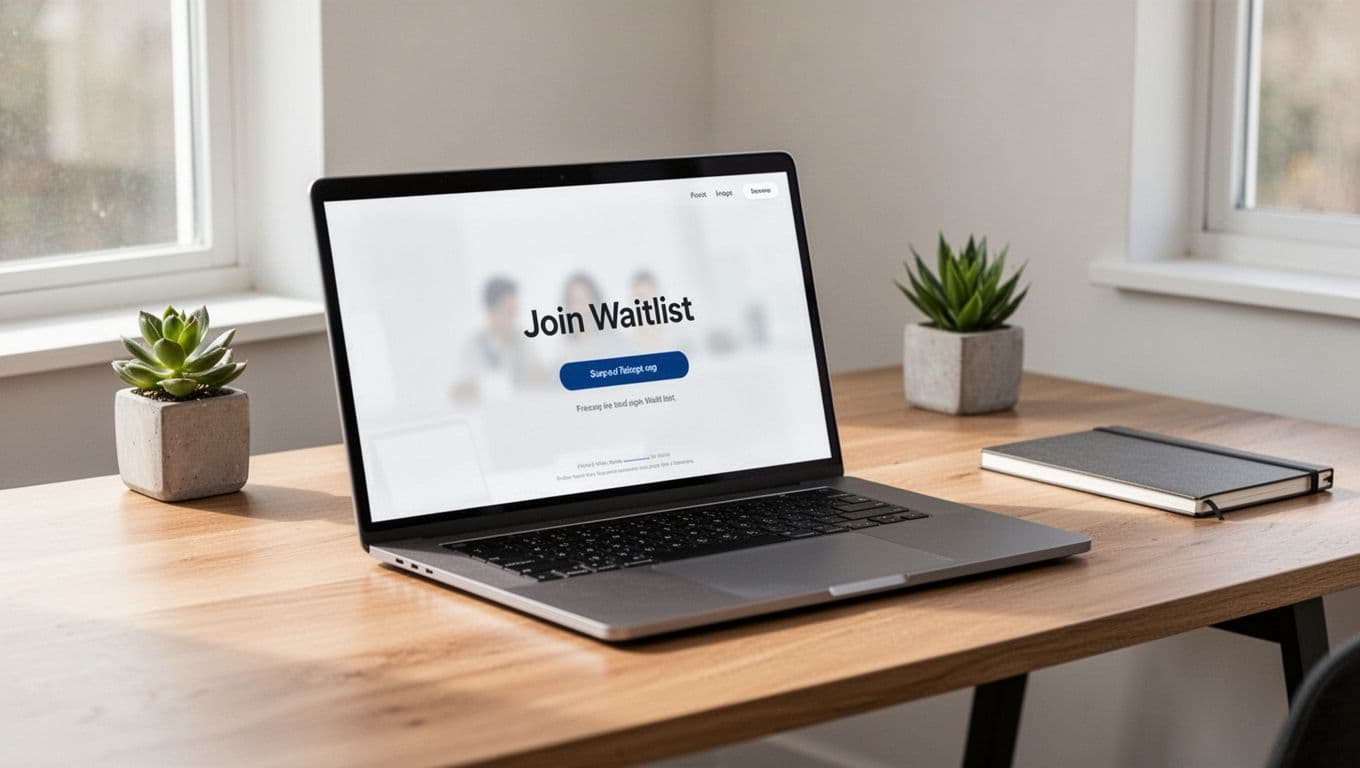 A simple waitlist-style landing page setup, created with AI.
Low-risk ways to test if people will actually pay
Validation should feel a little uncomfortable, because it involves asking for a real commitment. But it shouldn’t be expensive.
A few low-risk options that work in the real world:
A one-page website with a clear promise and price, a waitlist that includes the price (so you don’t collect fake interest), a pre-order with a delivery date, a paid workshop, a “minimum version” service you can deliver this week, a small pilot with 3 to 5 customers, or a short paid consult call that acts as both revenue and research.
The goal isn’t to hear “yes” from everyone. The goal is to hear enough honest feedback that you stop guessing. A “no” is useful too. It can save you months.
For broader 2026 context on what kinds of businesses still look durable even as AI changes jobs, Entrepreneur has a timely breakdown of businesses that may thrive in 2026. Treat it like a menu, not a prophecy.
And if you’re building something AI-powered, there are good examples of founders validating through community first. This story on a Reddit-launched AI fitness app is a reminder that early traction often comes from one clear place, not ten scattered attempts.
| Sector | Why it’s Winning in 2026 | Risk Profile |
| B2B Automation | Companies are desperate to cut costs using AI. | Low |
| Personal Branding/Coaching | Trust is the new currency in an AI-generated world. | Medium |
| Hyper-Local Services | Physical world tasks (HVAC, Solar) can’t be automated yet. | Low |
| Generalist SaaS | High competition from "Vibe Coders" and Big Tech. | Critical |
Avoid the early marketing trap: being busy is not the same as making progress
Early marketing has a sneaky trap: it can make you feel productive while producing nothing.
Posting everywhere, tweaking your bio daily, making five versions of a logo, chasing every new platform. It’s movement, but not always momentum.
A simpler approach tends to win early. Choose one main place to show up consistently for a few weeks. If your buyers hang out in local Facebook groups, start there. If they’re on LinkedIn, go there. If your product is visual, maybe it’s Instagram or TikTok. Pick one, commit, and track one or two outcomes like calls booked, replies, or sales.
Just as important, build a direct way to stay in touch. Email list, SMS list, even a simple customer list in a spreadsheet. If you only rely on algorithms, you’re renting attention. Owning a direct line to customers makes your growth steadier and cheaper over time.
If you like frameworks, Forbes suggests focusing on a few high-impact areas when starting a business in 2026. That kind of “less but better” thinking is exactly what keeps you from spinning out early.
If you already run a small business, use Q1 to keep holiday momentum alive
If you’re coming off a busy holiday season (or any peak season), you might feel two things at once: hopeful and tired. That mix is more common than people admit.
The mistake in Q1 is thinking you need a full overhaul to grow. Most small businesses don’t need a dramatic reset. They need to stay visible, stay in touch, and repeat what already worked.
Q1 is a “keep it going” quarter. You’re not trying to reinvent yourself. You’re trying to turn seasonal effort into year-round habits.
 A small business owner reviewing sales patterns and inventory, created with AI.
What to do with your holiday data so you are not starting from zero
Holiday season behavior is basically a free report on what customers actually wanted. Use it.
Look at your top products and bundles, the days you got slammed, and the messages that got the most replies. Notice who bought twice, who referred a friend, and what questions showed up again and again (those questions often become your best website copy).
Then turn those notes into simple actions. Restock the winners. Quietly retire the things that didn’t move. Write one “thank you” message and send it monthly (yes, monthly is enough for many businesses). Add one small promotion tied to what already worked, like a bundle that did well or an add-on that customers kept asking for.
And if the economy is on your mind, it’s smart to keep an eye on trends, but don’t let forecasts paralyze you. Here’s one example of a macro view that can help you think clearly without spiraling: economic forecast opportunities for small business.
What “on track” looks like in Q1 (even if growth is not huge)
In Q1, “on track” doesn’t always look like explosive growth. A better sign is momentum with existing customers.
You want evidence that people who already bought from you are still paying attention, and coming back. That’s a healthier signal than a random spike.
Here are a few grounded signs you’re building the year the right way:
- Repeat purchases and re-bookings are rising, even slightly.
- Email opens, replies, and clicks stay steady instead of falling off a cliff.
- Website traffic is modest but converts, not just random visitors.
- More referrals show up without begging.
- Support issues drop because your offer is clearer.
- Weekly sales feel less jagged, more predictable.
If your business is seasonal, compare Q1 to your own cycle, not to someone else’s Instagram revenue screenshot. The goal is steadier movement, not drama.
What I learned the hard way about starting a business (and keeping it going)
 Photo by RDNE Stock project
I used to think success came from doing more. More posts. More platforms. More “hustle” hours. I tried to be everywhere at once, and honestly, it made me feel important.
It didn’t make me money.
I remember one stretch where I posted daily on three apps, edited videos at night, rewrote my website copy every weekend, and still had the same quiet inbox. No calls. No payments. Just… noise. When I finally looked at what worked, it was embarrassing how simple the answer was. One channel had brought the only real leads, and I had been neglecting it because it wasn’t shiny.
Another time, I ran a small paid test almost as a dare to myself. It was a basic offer, nothing fancy. I asked for payment upfront, and I expected people to hesitate. A few did. A few didn’t. The ones who paid taught me more in one week than my previous month of planning. They told me what they actually cared about, what words they used, what results they wanted by Friday, not “someday.”
And here’s the one that still surprises me: following up with past customers was the easiest win I ever ignored.
I used to chase strangers because it felt like “real growth.” Then I sent a simple message to people who’d already bought, just checking in, thanking them, asking what they needed next. No big campaign. No fancy writing. That follow-up led to repeat work and referrals that felt almost unfair, in a good way. It reminded me that relationships are an asset. If you don’t stay in touch, you’re basically choosing to start over again and again.
So yeah, I still like new ideas. I still get that January buzz. But now I trust simple things more: one clear offer, direct contact with customers, small paid tests, and steady progress even when my plan isn’t perfect.
Why 2026 is the Year of the "Solopreneur"
The cost of building a MVP (Minimum Viable Product) has effectively dropped to near zero. Thanks to advanced LLMs, you can code, design, and market a brand with a team of one. However, the Barrier to Success has moved. In 2026, anyone can start, but only those with unique data or deep human connections will survive.
Key Takeaway: Don't start a business just because it's "easy" to build. Start because you have a "defensible moat" that AI can't replicate overnight.
Conclusion
Don't Wait for the "Dip" The most successful companies of the next decade are being built during this transition. If you have a problem to solve and a way to leverage current automation tools, now is the time. The "perfect time" is a myth—the "competitive advantage" of being early is a reality.
Next Step: Audit your business idea against the 2026 trends we’ve discussed. Are you building a bridge to the future, or a monument to the past?