


A lot of people are still hunting for a shiny, never-seen-before “New AI Business Idea”, like the winner must be hidden in some brand new invention. Then reality hits. In 2026, the people pulling ahead are usually doing something more boring and more effective: they’re using AI to build proven businesses faster than small teams ever could.
No promises here, and no hype. This model can work, it can also flop if the offer’s weak or the numbers don’t add up. But you can understand it in one sitting, test it without betting your life savings, and improve it in tight loops.
The big shift is simple: AI now gives a one-person or two-person team the output of a much larger team. That means execution speed matters more than secret ideas.
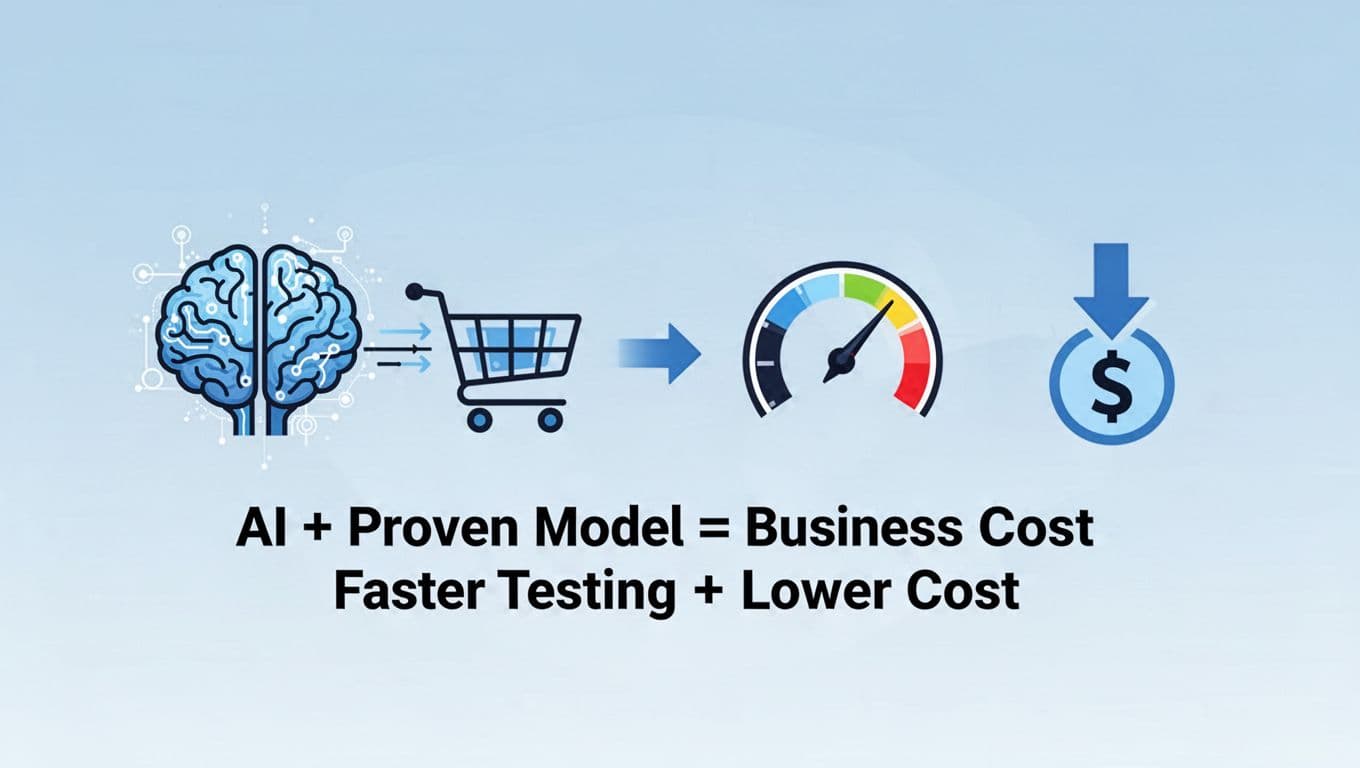 AI-made visual showing the core equation: AI plus a proven model equals faster testing and lower costs.
The model in one sentence: become an AI brand builder, not “another AI service provider”
An AI brand builder uses AI to speed-run the slow parts of e-commerce: product research, positioning, store setup, images, ad angles, emails, and basic support. Then you validate with small tests, keep what works, and scale the one offer that’s actually converting.
This is different from selling “AI labor” as a service. Agencies often sell tasks AI keeps automating, so fees get squeezed. It’s also different from faceless content farms, where the barrier to entry is low and the feed gets crowded fast.
Here, you sell real products. The product can already exist (often it should). The edge is your brand story, your page, your creative, and your ability to test fast. AI doesn’t magically make customers appear, but it can cut weeks of busywork down to an afternoon.
Also, when you hear “making millions”, pause. Most of the time that means revenue, not profit. A store can do $1M in sales and still feel broke if ads are expensive and refunds are high. Beginners should aim for first consistent profit, even if it’s small, because that proves the machine works.
For a broader view of where AI is pushing commerce this year, BigCommerce has a useful rundown on how ecommerce AI is transforming business.
Why e-commerce brands look more resilient than AI agencies and faceless channels in 2026
Some models get replaced by AI. Others get boosted by it.
Agencies are under pressure because clients can now do more in-house with better models and simpler tools. The work still exists, but pricing gets messy. Faceless channels have a different problem: when everyone can make “good enough” videos in minutes, the supply explodes and payouts don’t feel stable.
Physical products are stubborn in a good way. People still buy things they can touch. A strong brand can hold value even as tools change. And tools will change fast, they already do. What works today might be outdated in a few months, so you build skills and systems, not a single trick.
The three filters that decide if this model is worth your time
Before you start, run the idea through three plain filters:
- Can AI boost it instead of replacing it? If your “business” is just doing a task AI is about to automate, that’s a warning sign.
- Does it have profit potential plus brand value? Cash flow now is great, brand value later is even better.
- Can you start with low upfront cost? Time and money matter. Testing with light inventory risk is the whole point.
If that passes, you move to the system.
The simple 3-step system people are using to get profitable fast
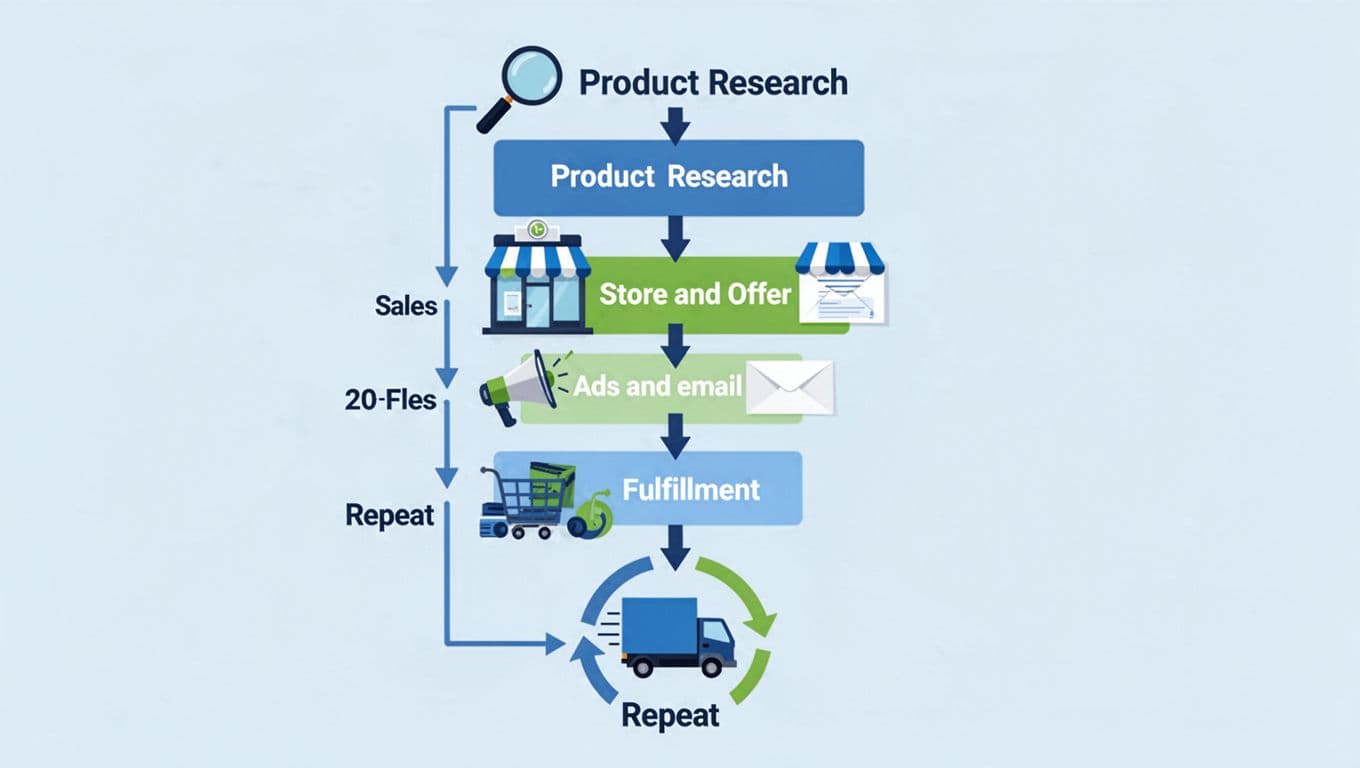 AI-made funnel showing the loop from product research to fulfillment and back to testing.
This isn’t complicated. It’s repetitive, and that’s why it works.
Step 1 is picking a product you can validate fast. Step 2 is making the store feel trustworthy so people don’t bounce. Step 3 is customer acquisition you can repeat: ads plus email, with enough variation to test new angles without rebuilding from scratch.
AI helps across all three. It can summarize competitors, draft landing page copy, generate ad hooks, write email flows, and create realistic creatives without begging friends for a photoshoot (I’ve done that, it’s… a lot). The win is speed. While someone else spends days scrolling supplier listings, you’re already testing.
If you want a more hands-on walkthrough of the AI-driven dropshipping path, this internal guide is solid: AI-powered dropshipping guide 2026.
Step 1: Find a product you can test in days, not months
AI is good at narrowing the field quickly. You can feed it competitor links and ask for patterns: what’s the core promise, what objections show up in reviews, what bundles make sense, what price range looks realistic, and where margins might break once shipping and ads are included.
A few guardrails keep you out of trouble:
- Avoid obvious IP issues (logos, characters, knockoffs).
- Avoid products with high breakage or complex setup.
- Prefer items with a clear “before and after” benefit, something you can show in 5 seconds.
- Leave room for margin after shipping, returns, and payment fees.
Here’s the uncomfortable truth: many winners already exist. You’re not “inventing”, you’re packaging and marketing better. That’s normal. That’s business.
Step 2: Make the store look trustworthy, even if you start lean
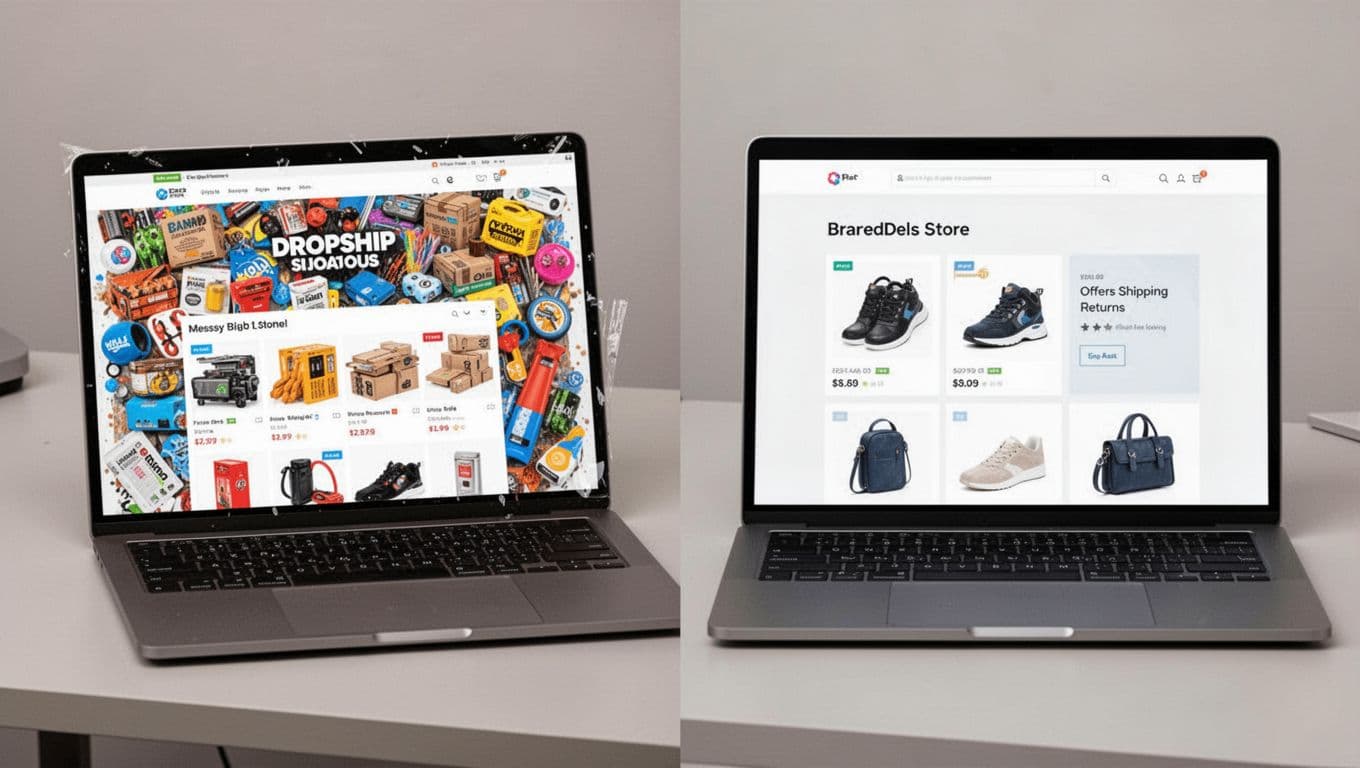 AI-made comparison of a messy dropship-style page versus a clean, branded product page.
Most beginner stores fail for a simple reason: they look scammy. Random products, inconsistent photos, weird claims, confusing shipping info. People don’t even get to your offer, they exit.
AI can help you fix that fast. You can generate consistent product photos, match lighting and style, draft a basic logo, and write clean page sections that actually answer what buyers care about.
What builds trust quickly is not fancy design, it’s clarity:
- A clear offer and who it’s for
- Honest shipping time and tracking expectations
- Returns policy that doesn’t read like a trap
- Reviews (real ones, collected over time)
- FAQs that handle common objections
- Simple copy that sounds like a human, not a brochure
How the money actually works (and where beginners lose it)
E-commerce math is boring, but it’s the whole game.
You have a selling price. Then you subtract product cost, shipping, payment fees, ad spend, returns, and support time. What’s left is profit. AI can reduce creative costs and speed up iteration, which helps margins, but it doesn’t eliminate ad spend and it doesn’t save a weak offer.
If you want a grounded perspective on what business leaders expect from AI this year, PwC’s 2026 AI business predictions are a useful read.
A quick “can this be profitable?” checklist before you run ads
Keep it simple, like a friend checking your homework:
- Can you still have healthy margin after shipping and fees?
- Is the promise believable, and can you show proof or demo?
- Does the product solve a real annoyance or pain, not a fake one?
- Is there a clear angle (time saved, comfort, safety, simplicity)?
- Does your page make the purchase feel safe (returns, contact, FAQs)?
If two or three of these feel shaky, don’t “push through”. Adjust first, then test.
Operations that stay simple: start with low-risk fulfillment, then upgrade
Early on, stay light. Use dropshipping or a 3PL-style partner so you’re not buying piles of inventory before you’ve proven demand. Once you see consistent sales and stable refund rates, then you upgrade: better packaging, faster shipping, maybe a customized version of the product.
This part matters because fulfillment mistakes don’t just cost money, they cost trust. Late deliveries and missing tracking turn into chargebacks, angry emails, and bad reviews. When ads finally work, ops has to keep up, or the whole thing collapses in a week.
What I learned trying to build with AI in 2026 (the honest version)
I’ve learned that chasing novelty is a trap. It feels productive, but it’s mostly procrastination with a cool label.
AI speed is real though. It’s wild how quickly you can go from “idea” to a store, basic creatives, and an ad test. The catch is that tools change fast, so you can’t get too attached to one workflow. You keep the mindset, swap the tools.
One mistake I made early was overtesting. I had five product ideas, so I tried to test all five. Sounds smart, right? It wasn’t. The data got messy, my creatives were rushed, and I couldn’t tell what was failing, the product or my ad angle. Once I forced myself to focus on one offer, rewrite the page, and run cleaner tests, results started to make sense.
And yeah, “AI-generated everything” doesn’t build trust by itself. Brand trust still wins. People buy when it feels safe.
Conclusion: proven business plus AI speed, not a fantasy
This model works when you treat it like a loop: proven product category, faster execution with AI, small tests, then scale what earns real profit.
In the next 48 hours, keep it basic: pick a niche you can stick with, shortlist a few testable products, run a tiny validation test (even just a landing page plus a small ad spend), and build the minimum trustworthy page. Track the numbers, not the noise. Then keep learning, because the tools will change, but the business math won’t.